

Pancho Villa, born José Doroteo Arango Arámbula, led a fascinating life. Everyone knows the name, but it’s unlikely many know the man. I knew nothing about him outside of two facts: He participated in the Mexican Revolution, and General “Black Jack” Pershing and the US Army attempted to catch him.
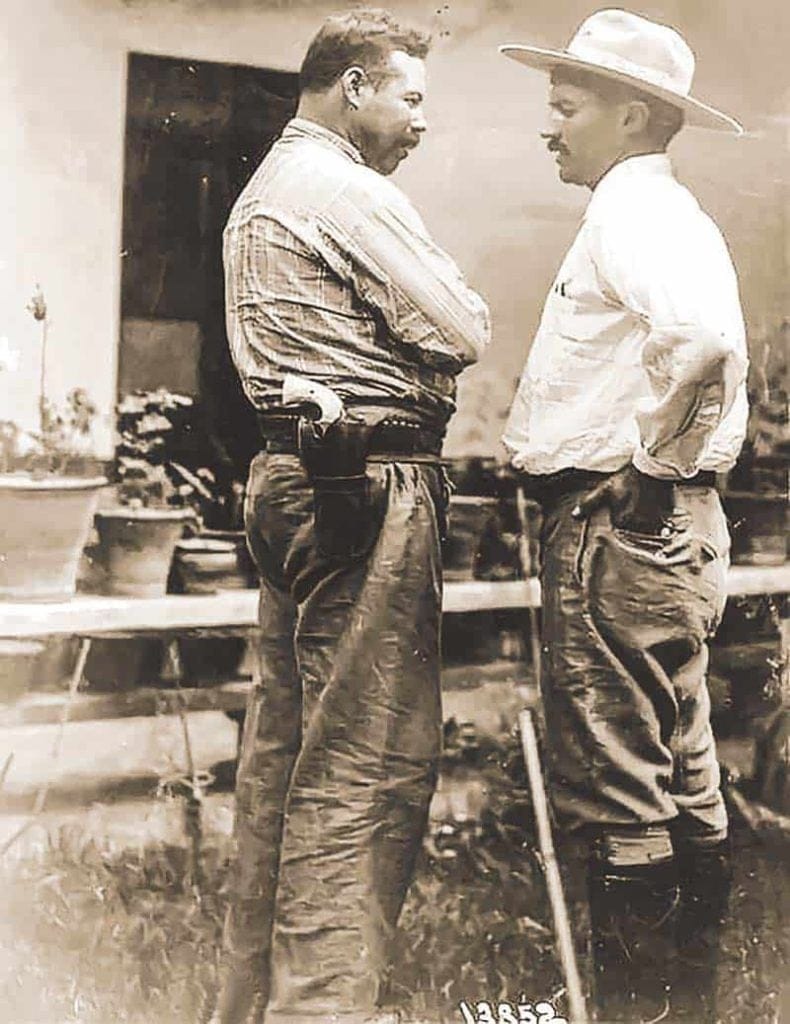
That’s it, and I know he was a bandolier enthusiast. Lately, I’ve been reading, studying, and learning about the man, the myth, and the legend of Pancho Villa. It’s oddly fascinating what drew my interest in the man. It was a singular photo of him shooting a Bisley Colt. I like Bisley Colts, and the fact that Pancho consistently carried one made me feel a slight kinship to the man, even though I knew nothing more about him.
Colt Single Action Army Bisley Model
There are several photos of Pancho with his Bisley Colt. The distinct Bisley grip design makes the weapon easy to spot. Colt designed the Bisley grip to reduce the effects of recoil. Most Colt Single Action Army revolvers have plow grips, and they tended to roll rearward when fired. The rolling had the benefit of allowing the shooter to easily reach the hammer and cock the weapon for the next shot.
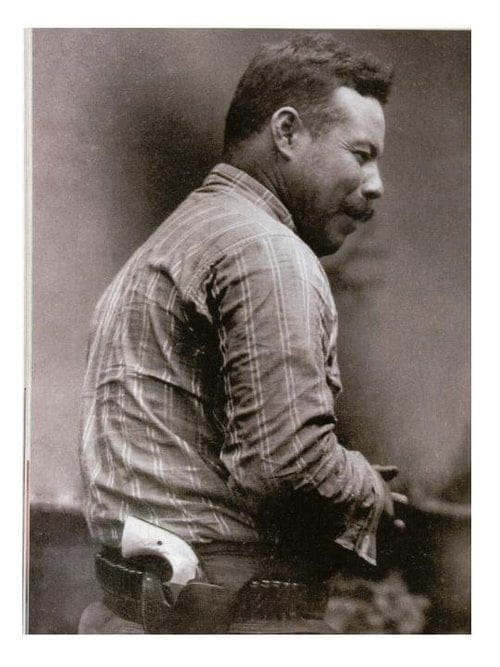
Pancho Villa utilized the .44-40 round in his Colt, which was popular and powerful. The popularity came from the famed Winchester lever-action rifles chambered the round. You could carry a rifle and revolver that used the same ammo. Pancho liked his Winchesters, but I couldn’t find where he used a .44-40 rifle.
If you ever want to see it in person, Pancho’s Colt Bisley occupies a display at the Autry National Center Collection.
Winchester 94
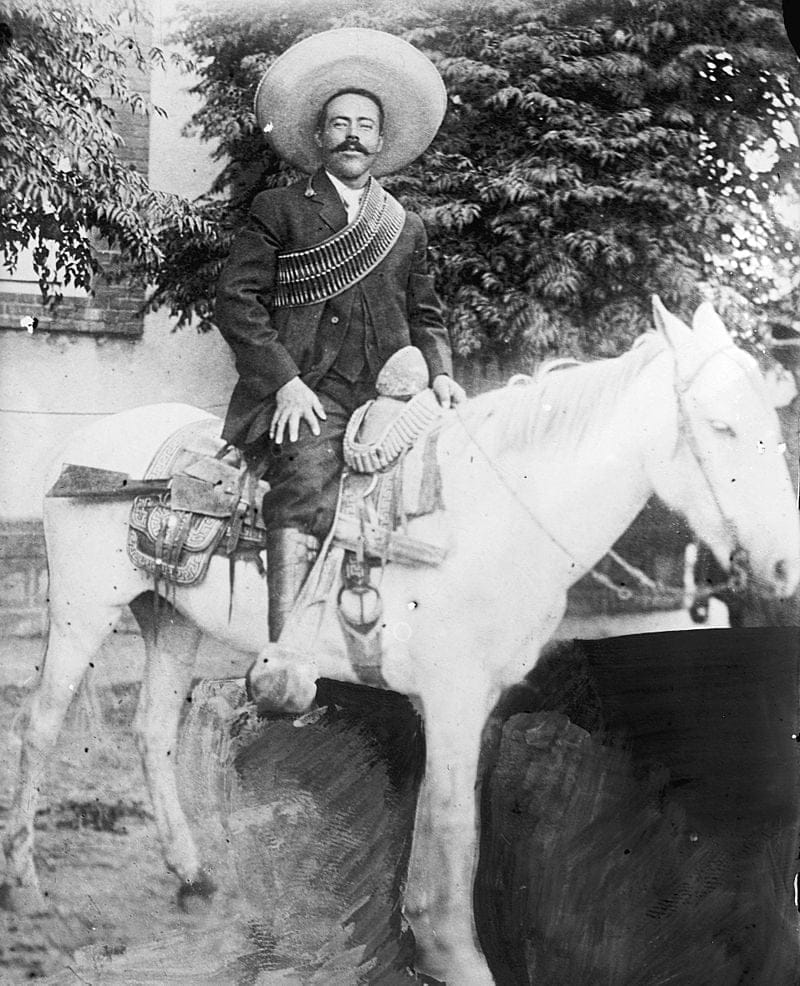
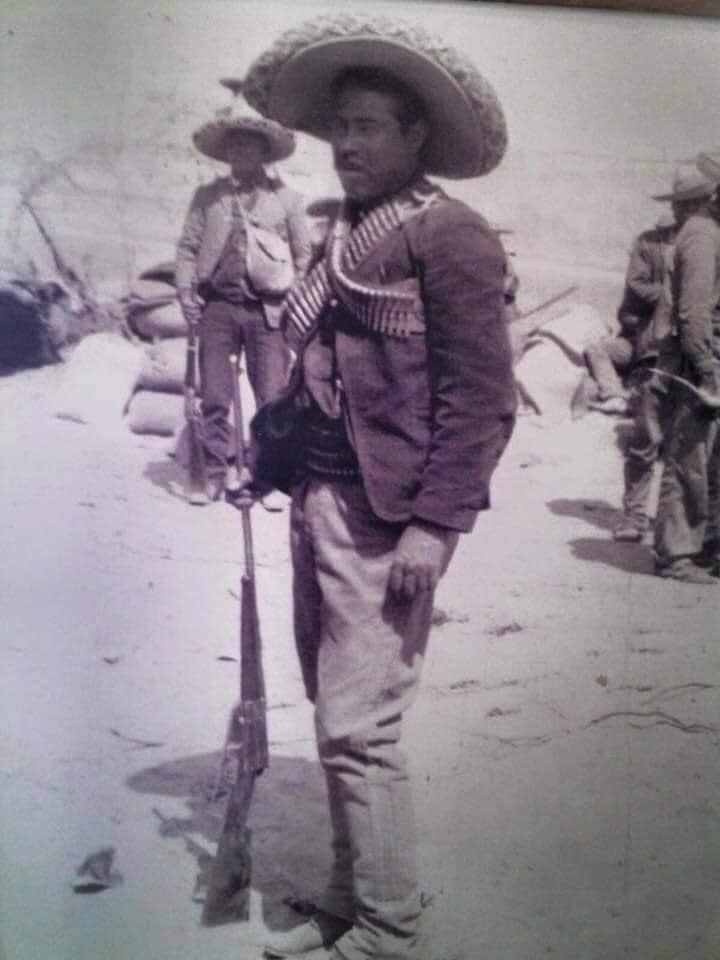
Most photos of Pancho Villa feature the famed crossed belts of ammo. These bandoliers are eye-catching and just plain cool. As a machine gunner, I also carried ammo belts across my chest (until a Staff Sergeant shouted at me.) If you look closely, you’ll likely notice one of his bandoliers tends to have regular Spitzer rifle bullets, and the other has rounded projectiles that look handgun-like but are clearly rifle-length. They appear to be .30-30 cartridges, which ties in nicely with Pancho’s love of Winchester rifles, specifically the Model 94.
A lever-action rifle made sense in the fast-moving conflicts, raids, and chases of the Mexican Revolution. It wasn’t always your typical infantry conflict with extended conflicts at long ranges. Even city-based sieges often devolved into close-range combat, and at the time, the fast-firing nature of the Winchester 1894 must have been an asset for Revolutionaries.
Based on an examination of their photographs, I noticed at least two different variants of the rifle in Pancho’s possession. At this time, the fact that the rifle fired a smokeless rifle round likely made it an excellent choice for a combat tool for the era and situation.
Winchester Model 1895
Another rifle common with Mexican Revolutionaries was the Winchester M1895. These rifles had an odd path to Mexico. They were initially purchased for the US Army and tested. Later, they were found lacking and sold to a private company, who then sold the rifles worldwide, including to Cuba and Mexico. They became popular during the revolution, and Pancho was photographed with one such rifle.
Pancho appears to be sporting a variant with a short stock. Military models often have longer handguards and bayonet lugs. It’s unlikely this was a military surplus model, but perhaps a private purchase? One side of Pancho’s bandolier held spitzer-type rounds, and maybe those rounds were for the M1895?
While Pancho wasn’t known to publish his opinion of firearms, the Army had trouble with the M1895 rifles. These guns were slow and clumsy to load. Soldiers reported they were easily gummed up with dirt and sand, something Mexico has in abundance. It’s unclear how well these rifles performed, but revolutionaries tend to be less picky about their armaments.
Mexican Mauser Model 1910 Carbine
One rifle that occupied the hands of both revolutionaries and Federales alike was the 1910 Mauser Carbine. At the turn of the century, the bolt-action repeating rifle was taking over worldwide armories. These rifles used the new smokeless powder cartridges and saw a shift from big 45 and 50-caliber projectiles to much smaller, faster cartridges.
The Mauser design ruled this era. It was the M16/M4 of its era. The rifle was everywhere, and when the US developed the M1903, it was found to be so similar to the Mauser in design that the US had to pay a royalty.

Pancho Villa was photographed carrying one in a sheath on horseback. He used the shorter Carbine model. The bolt-action rifle was a modern weapon for the era, allowing for long shots and accurate fire. It was simple but very rugged, and the ammo was common due to its use by the Army.
According to legend, Pancho Villa’s Mauser Carbine was stolen by lawman Elfego Baca. Pancho put a $30,000 price on the man’s head. Baca was known for tall tales, so who knows the truth?
The Man, the Myth, the Legend
It’s always tough to separate fact from fiction when you have larger-than-life characters. Men like Pancho Villa were certainly larger than life. He lived a life of a thief, a highwayman, and eventually a notable revolutionary. He even retired, but like all important revolutionaries, he died in a hail of gunfire. Part of that legend states he died reaching for his Colt Bisley, but who knows for sure?
