

Fabrique Nationale and John Browning’s partnership would produce dozens of different firearms. While some are quite notable, like the Auto-5 and large parts of the Hi-Power design. In between those two weapons sits a number of small or compact handguns designed for those refined European gentlemen and women. One such pistol is the M1922. Today we’ve got our hands on an M1922, and we’ll explore its function, its history, and exactly how it handles.
Basics of the M1922
The M1922 is a blowback-operated, striker-fired handgun that chambered either the 32 ACP or the 380 ACP cartridges. Both cartridges were invented by John Browning. The weapon feeds from a detachable magazine that holds either 8 or 9 rounds, depending on caliber. Our model is a 380 ACP variant.
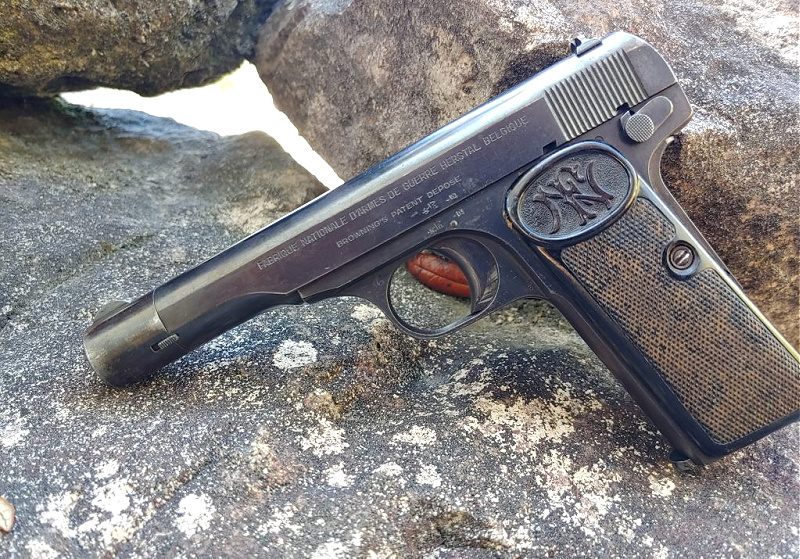
The weapon has both a manual safety, a magazine safety, and a grip safety. The manual safety doubles as a means to manually hold the slide open. However, the weapon does not have a last-round slide hold-open device. The magazine release sits on the bottom of the frame and is a typical European-style magazine release.
The Origins of the FN M1922
The FN M1922 descends from the FN M1910. The FN M1910 is another John browning design, and the M1910 and M1922 are the same basic gun, except for the fact that the M1922 wears a longer barrel, slide, and grip. The M1910 famously killed the Archduke and began World War 1.

FN designed the 1922 variant for military and police contracts. The M1910 was fairly small and concealable and, as you’d imagine, not necessarily suited as a duty firearm. The 380 ACP or 32 ACP cartridge choice doesn’t seem like your typical military chambering, but they weren’t that uncommon for European military forces. Pistols were more ornamental—thin and not exactly a weapon mostly used for fighting.
The longer barrel and grip would help secure those contracts. A longer barrel meant a longer sight radius and greater potential accuracy. The longer grip offered more control and one extra round. While larger, the FN M1922 is still a thin, svelte gun. Compared to something like the M1911, the M1922 seems dainty and small.
The FN M1922 In Service
The FN M1922 would go on to see use by Yugoslavia, Serbia, Belgium, the Netherlands, Turkey, Greece, and many more. It became a rather popular pistol. Even Japanese officers reportedly purchased these firearms for their military service.

By the time World War 2 came along, the pistols were being used by both sides of the war. The Germans seized the FN factory when they occupied Belgian and produced the pistols, creating the rare and pricey Nazi marked model. A member of the Dutch resistance used an FN Model 1922 to assassinate a Nazi collaborator.
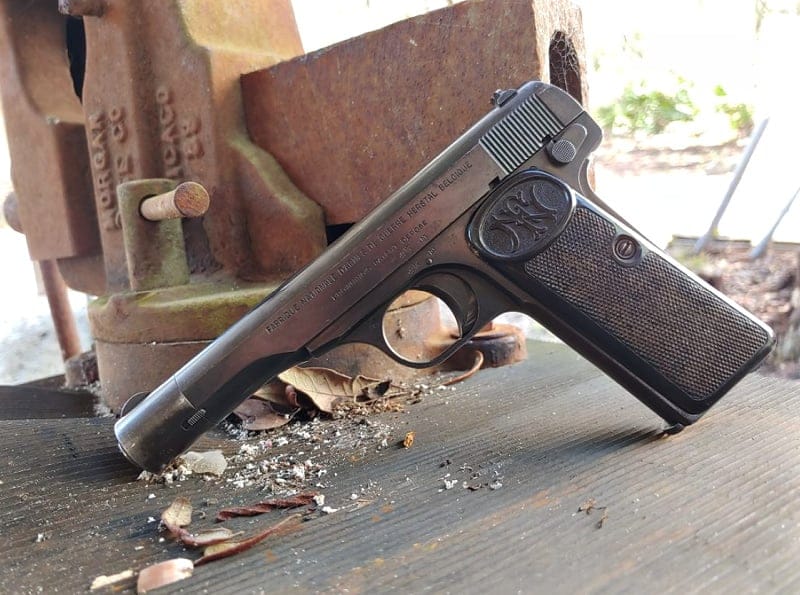
In the post-war period, these pistols were used in West Germany and eventually would be imported to the United States in numerous configurations. They also popped up in Peru and Venezuela. They are simple guns in popular calibers. It’s no surprise they’ve become so widespread.
In Living Color
My FN Model 1922 is of no special parlance. It’s not a Nazi-marked model and doesn’t feature any crazy history. It’s quite plain with the FN plastic grips, and it still has a pretty finish left on it. The magazine is marked 7.65, indicating it’s a 32 ACP model, but the magazine fits 380 ACP. It’s likely this is not the original magazine, but it works just fine.
The differences between the 32 ACP and 380 ACP models are very small, and you can apparently swap calibers by just swapping barrels. Sadly I can’t seem to find a 32 ACP barrel to do just that. The grip is remarkably svelte and thin, and it feels quite well in the hand.
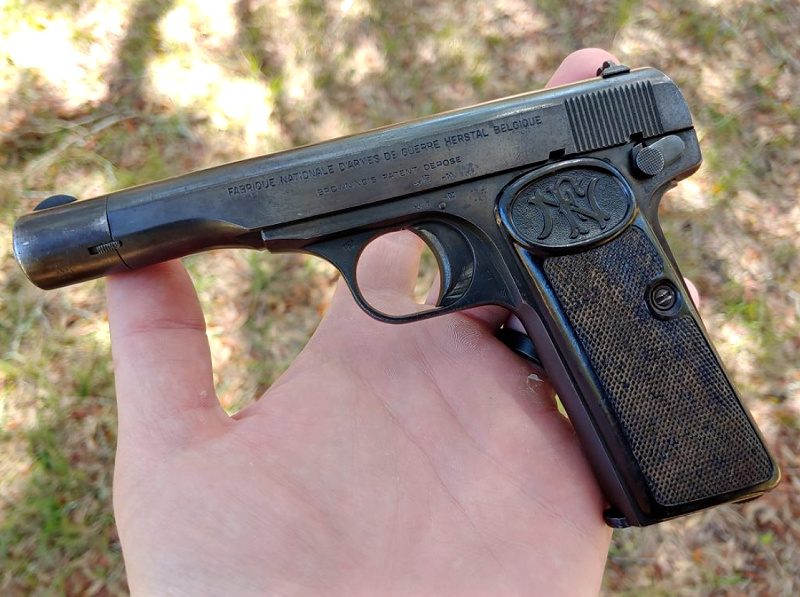
The gun is straight blowback, but since it’s a 380 ACP, the recoil spring isn’t very heavy. Racking the weapon doesn’t present much difficulty. Interestingly enough, the FN M1910 and FN M1922, by extension, were the first guns to use a recoil spring attached over the barrel. This design feature would carry over to weapons like the Walther PPK.
The manual safety is a textured circle that slides up and off easily enough. The grip safety is hardly noticeable. When you combine those two safeties with the magazine safety, and you get the ‘Triple Safety’ design that came to be with the FN 1906 25 ACP.
At The Range
With a box of 380 ACP and a heart full of anxiety, I hit the range. You never know when an old gun just won’t work, and it’s part and parcel of collecting. I loaded it up, established a good firing position, and pulled the trigger. Bang it went, and it continued to bang without issue over the next few magazines.
The recoil is stiff but not painful. It’s not a small gun, but it’s direct blowback. That means of operation imparts a fair bit of recoil. Even so, it was still plenty pleasant to shoot—no slide bite or grip safety pinch.
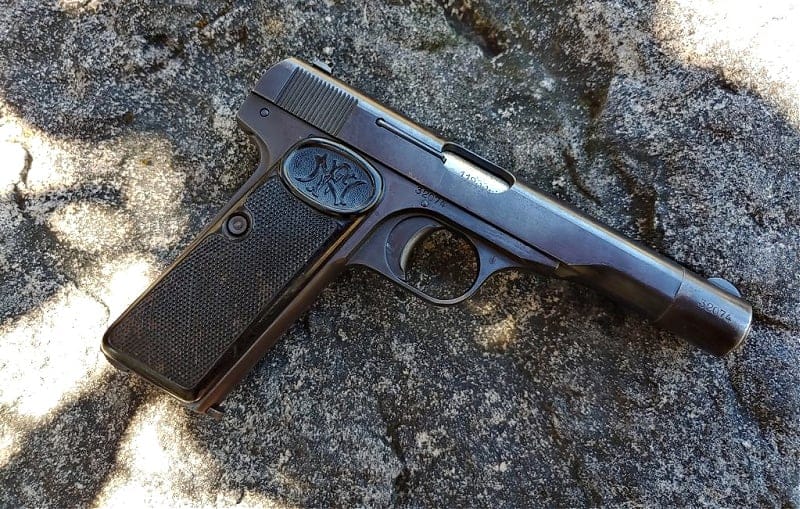
In the early days of semi-autos, sights seemed like an afterthought. They are a tiny notch and post that’s tough to see on a good day. To hell with trying to react to a threat rapidly. Accuracy is about what you’d expect. It’s not bizarrely accurate like the Astra 600, but completely acceptable for its size and caliber. Shooters can group ten rounds into a fist-sized group at 15 yards easy enough.
Triggerwise, the FN M1922 features a fairly short but stiff trigger pull. The magazine disconnect likely hampers its total potential. Still, it’s a fun gun to shoot and an interesting piece of history.
That Little Belgian Pistol
The FN M1922 served surprisingly long, and as a member of the M1910 family, it seems to be one of the preferred pistols for European assassins. Why? I’m not sure, but they are robust, reliable, and easy to shoot pistols. It’s no surprise they’ve lasted for this long and have become a common pistol on the surplus market. If you can get your hands on one, I do suggest you do!
