

It has been more than a quarter century since Glock introduced the “baby Glock” line. Essentially, they were full-size Glocks “chopped and channeled” to about the weight and the size footprint of a six-shot snub-nose .38 Colt Detective Special revolver, but holding 10+1 rounds of 9mm in the G26 and 9+1 of .40 S&W in the G27. They were later followed by the G33 in .357 SIG and the G39 in .45 GAP. There was also a .380 caliber G28, which was not marketed in the US until very recently when it was produced at the US factory in Smyrna, GA due to the provisions of the Gun Control Act of 1968.

We’ll focus here on the 9mm Glock 26, the smallest of Glock’s standard size 9mms as seen at far left in the lead photo, inserted above.
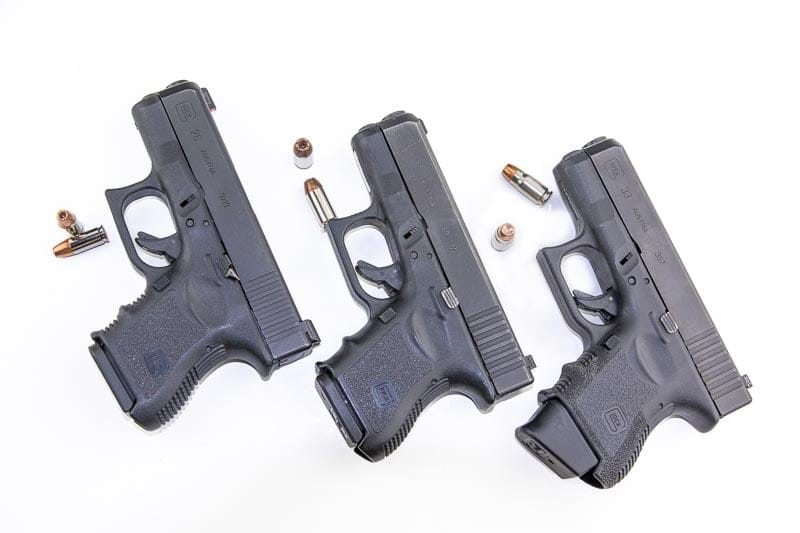
When the G26 and G27 came out in the mid-1990s, I tested them both for gun magazines. They both performed very well, and I bought both test samples. At the time, I was more comfortable with the .40 power level than that of the 9mm and carried the 27 far more often than the 26; that preference increased in the early 2000s when for about three years, I carried a .40 caliber Glock 22 on duty and used the G27 as a backup gun in an Alessi ankle holster. If the G22 was not accessible or snatched, the 27 would take the same 15-round .40 mags and still leave me with a gun and two reloads to fight with.
The 26 was used less often and only to back up a larger Glock 9mm for the same reason. The 26 rode on my ankle only twice in the early years, both times when I went places where I wasn’t sure I wouldn’t need a lot of rounds. The first of those was when I went to Littleton, Colorado a few days after the atrocity at the Columbine High School to debrief the cops who had responded. In those early days, it wasn’t certain that other “trenchcoat mafia” types wouldn’t be taking action, and the 26 backed the G17 inside my waistband with a couple of spare 17-round mags of hot 9mm JHP. Halfway into the first decade of the 21st Century, I was an expert witness for the involved officer in a high-profile case of the killing of an Aryan Brotherhood lieutenant by the cop in question. There was a “contract out” on the cop and threats to everyone who spoke for him – there were SWAT snipers on the roof of the courthouse, and traffic diverted for blocks around – and lots of bullets seemed like a good idea, so the G17/G26 combo again came into its own.
Over the years, I switched from the .40 caliber Baby Glock to more time with the 9mm version. Here’s why.

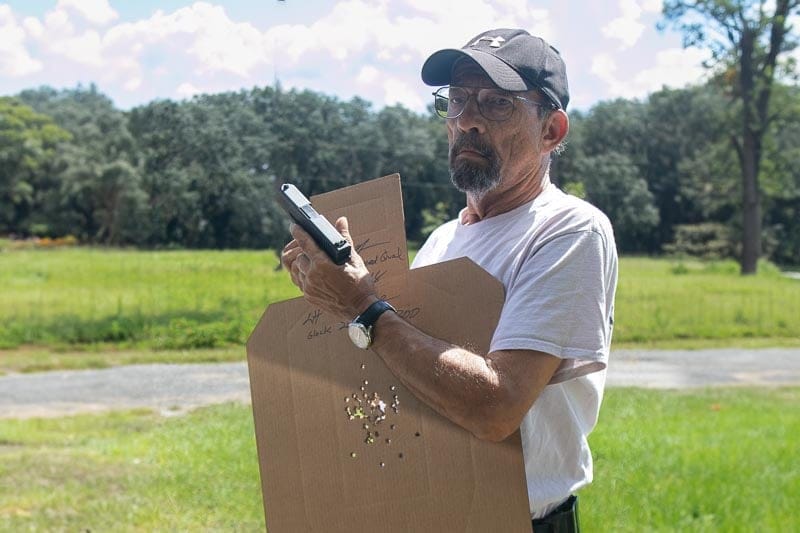
The Baby Glocks, across the board, are amazingly accurate. My first G26 averaged 2.5” groups at 25 yards, better than my first full-size G17. (My first G27 was way more accurate than my full-size G22; the little .40 once gave me five shots in 1.5” with 155 grain Winchester Silvertip .40 from an impromptu bench rest at 25 yards. Only with the Black Hills 165 grain JHP .40 could my G22 compete with that.)
Glock-o-philes believe that this improved accuracy was due partly to the double-captive recoil spring that kept the gun in battery until the bullet left the barrel and partly to the rigidity of the relatively shorter, thicker barrel. The same was true of the subcompact large frame G30 in .45 ACP shooting tighter than the also very accurate G21 full-size .45 ACP. This may be why double-captive recoil springs were part and parcel of later Gen4 and Gen5 Glocks in larger sizes.
Shootability
Back in the late ‘90s, as a lark I shot an IDPA match with my early G26 and won, shooting against G17s and other full-size guns in the Stock Service Pistol division. A decade or so ago my friend Danny Ryan, moderator of the GSSF (Glock Sport Shooting Foundation) section at the popular gun forum GlockTalk.com, remarked that several master shooters had won Glock matches overall with Glock 26 pistols, beating all scores fired with bigger service pistols including their own scores with the bigger guns. I tried it in a few matches and found out my G26 scores were the same as with the G17, and ever since, I have shot with the 26 in all 9mm events there and still won my share of guns and other prizes.
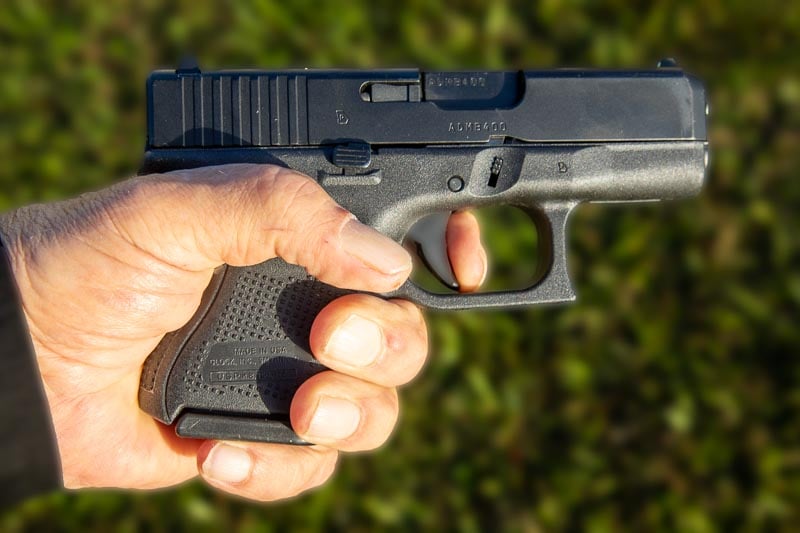
What makes the baby Glocks so “shootable”? For one thing, the shorter slide seems to have less recoil mass moving rearward, coming back on target fast enough to more than compensate for their lighter overall weight. Another point: the Baby Glock’s backstrap has more of a curve to it, which locks exactly into my palm for a steadier hold.
Versatility
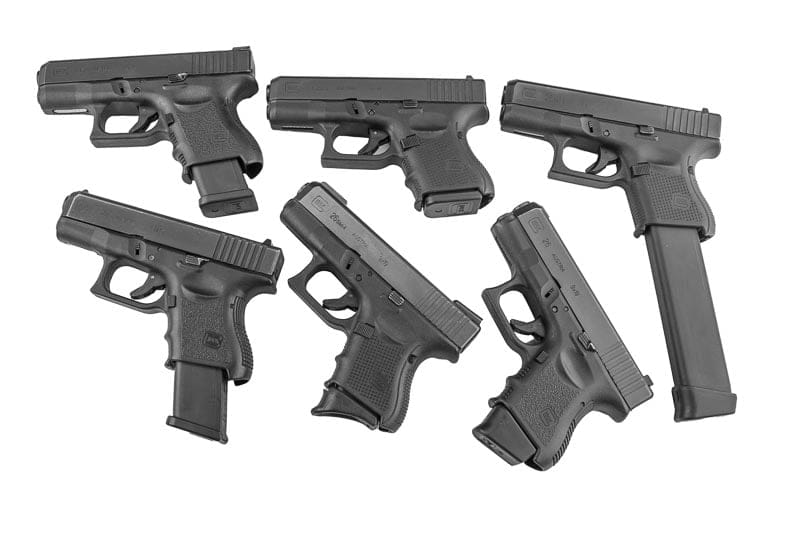
There are slimmer 10+1 shot 9mms in the Glock catalog and elsewhere, and some that take more rounds. But the G26 will take all the larger mags for the same frame size: 15, 17, 24, and even 33 rounds. Good street results with rounds like the 124 grain Gold Dot +P (NYPD, Las Vegas Metro) and others have largely “taken the worry out of carrying 9mm.” Yes, with a short 10-round magazine the G26 leaves you no place for your pinky finger, but tucking it under the butt tightly gives you most of the control you’d have with an all-fingers grasp.
If you live (or have to carry) in a ten-round limit state, I would advise owning three types of magazines from Glock. The stubby 10-rounders they come with for deep concealed carry, since their bottoms protrude less; at least one with a Pearce grip extender (not the one that adds another round of capacity, because it’s a felony per magazine in New York state); and some 10-round G17 magazines for reloading. The longer mag isn’t hard to conceal, but it won’t pinch your pinky finger on the reload, which creates a blood blister but more importantly, blocks insertion. I don’t care for the 10-round G19 mags: they’ll fit a 26, but it will be so tight-fitting at the top they’ll be hard to insert if the slide is forward, and can create friction drag on the underside of the slide when recoil cycles the gun, which at least in theory could cause a malfunction.
When the Baby Glocks came out in the mid-90s, Glock execs told me sales were about equal between the 9mm and the .40. Soon, the .40 S&W round being at its peak of popularity, G27 sales exceeded G26 sales for a while. Now, it’s no surprise that the G26 is the best-selling of the chopped and channeled standard-frame Baby Glocks…and still a very popular and very effective self-defense choice.

It broke my heart when arthritis and reduced hand strength forced me to give up my G26 Gen5 two years ago. I still consider it the best carry gun I’ve ever owned.