
It all began in 2018 when Sig Sauer released the P365 micro-9mm pistol. It’s very small and carries a healthy amount of 9mm rounds, and life was grand. Some folks thought it was just about the “pistol to end all pistols.” The size and weight ratio is excellent, and it’s very comfortable to carry, shoot, and conceal.
Despite that, Sig did what some other companies did after releasing a wonderful micro-9 pistol — they released another one that was just a little bit larger! But why? Wasn’t the original pistol perfect?

As humans, no matter how well we do something, we seem to need to tinker with it just a little bit more. Perfecting perfection.
So how about it: is the P365XL any better than the standard P365? What are the differences? Are those differences true improvements, or are they just a way to help customers part with more cash?
I’ll give you straight answers that might surprise you.
Sig Sauer P365
Tech Specs
The Sig Sauer P365 is a 9mm pistol weighing 17.8 ounces with an overall length of 5.8 inches and a height of 4.3 inches. The thickness is one inch. The barrel length is 3.1 inches, and the pistol is rated for +P ammunition. Forward serrations adorn the stainless steel slide, which has a Nitrolon finish. The slide’s edges are beveled and melted, so there are no sharp edges, and the pistol holsters easily because the front edges of the slide are also beveled.
Although they are available with a manual safety as an option, my pistol does not have one.
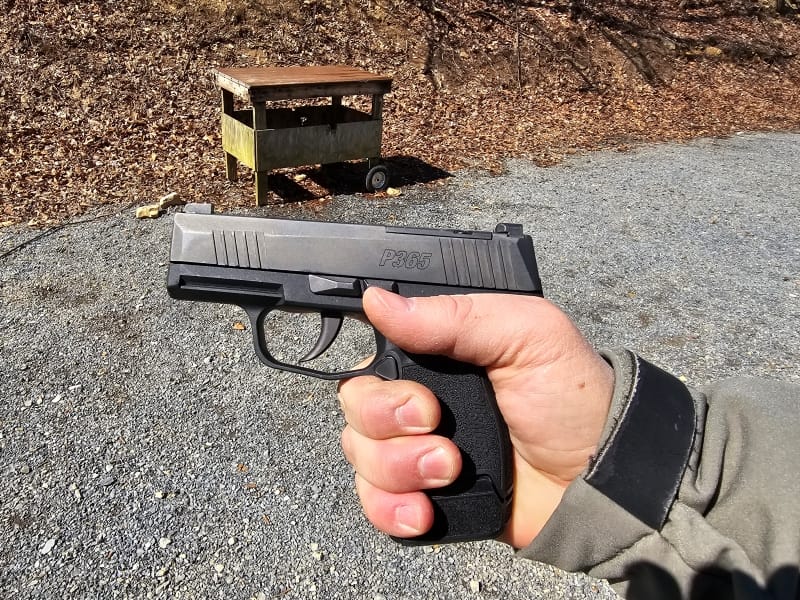
The three-dot sights have tritium inserts, so they are highly visible in low-light environments, which is a wonderful touch by Sig. The front sight has a large, green circle around the central dot, which makes it more visible than the rear sights. The dots in the sights could be a little brighter for my taste to make them easier to see, but they work well enough.
The frame is polymer, so it’s nice and light. There is a serial numbered Fire Control Unit (FCU) that fits into the frame and is actually considered to be the firearm. This FCU can be removed and switched out to other pistol frames. Essentially, one FCU can comprise several pistols.
There is an accessory rail, but the downside is that it’s a proprietary design and does not conform to Picatinny specs. I think Sig would have done well to make it Picatinny-compatible, giving versatility to the lights that could be mounted on the pistol. I’m not a big weapon-mounted light guy, so I don’t personally care too much.
This P365 cost me $495 at a local gun shop. Sig did not send me this pistol, nor did they help in any way with this article.
Magazines
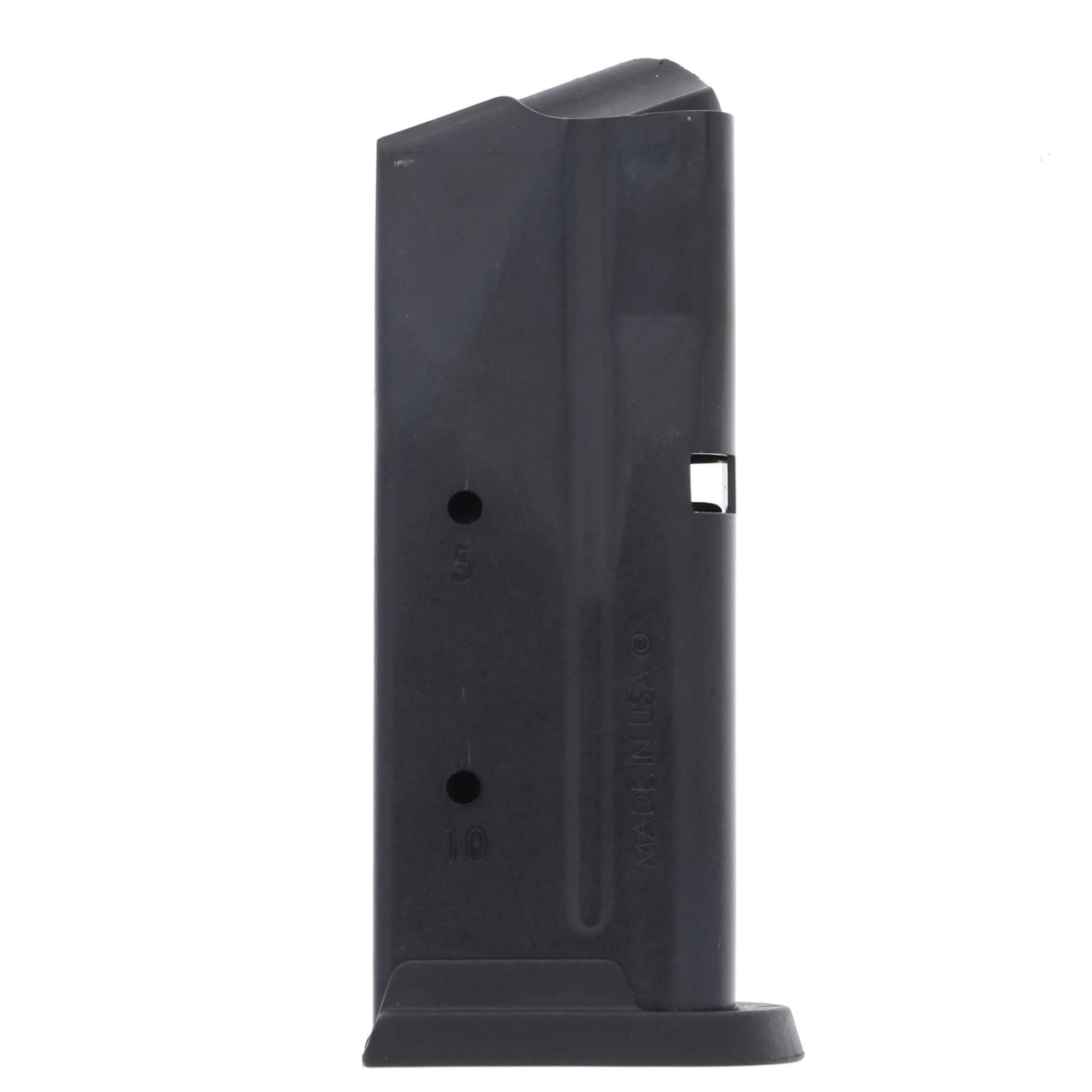
The P365 comes with two metal 10-round magazines: one with a finger extension and the other with a flush-fit design. I prefer the one with the finger extension, but even with that one, the rear of the magazine has no support, and the edge of the grip presses into the lower edge of my hand. It’s nice for concealment but less than completely comfortable in the hand.
I opted to pick up a 12-round magazine with a full extension on the base plate. This gives the grip a full extension, offering more support to the base of my palm, which I strongly prefer. Beyond that, the 12+1 capacity offers a perfectly balanced size and weight ratio, making it a great carry piece.
There are also 15- and 17-round magazines available for the P365 (they also fit larger pistols in the P365 line).
Grip
As I mentioned, the basic grip of the P365 is a little short and digs into the palm of the hand a bit. That said, it’s the nature of the beast. After all, it is a micro-9 pistol, so what would we expect? A large part of the attraction is the fact that it’s a very compact pistol.
Beyond that, the grip is pretty amazing. The stippling is textured so that it won’t slip in the hands when wet, but it’s not so abrasive that it will hurt the skin or ruin clothing like some other pistols on the market.
There are two very, very subtle finger grooves on the front of the grip. They’re just there enough to be perceptible but not pronounced enough to be offensive. In my opinion, they enhance the grip and are a positive thing. And the grip is slim! Marvelously slim and comfortable!
Sig added an undercut beneath the trigger guard so shooters can get a nice, high grip on the pistol.
Trigger
While I love the P365 system, the trigger is not a selling point for me; rather, it’s something that I tolerate.
The P365 series is striker-fired, so it has the usual take-up that all striker-fired pistols have. Then the wall is hit. Rather than breaking the wall crisply, the P365 goes through a period of creeping. Yes, ladies and gentlemen, creeping and crawling that is mushy, after which we arrive at the break. It’s not the worst trigger I’ve ever experienced, but it’s far from the best. This is probably my biggest gripe about the 365 series.
Controls
The magazine release is triangular in shape and lends itself well to jettisoning the magazines. The slide stop/release is on the small side, as is the trend these days. However, it has enough thickness that it protrudes far enough out so that the thumb can actually operate it, which I find refreshing. Aside from that, there is only the takedown lever left, and it is easy enough to operate.
Overall, I love the controls on this pistol series; they work great.
At The Range
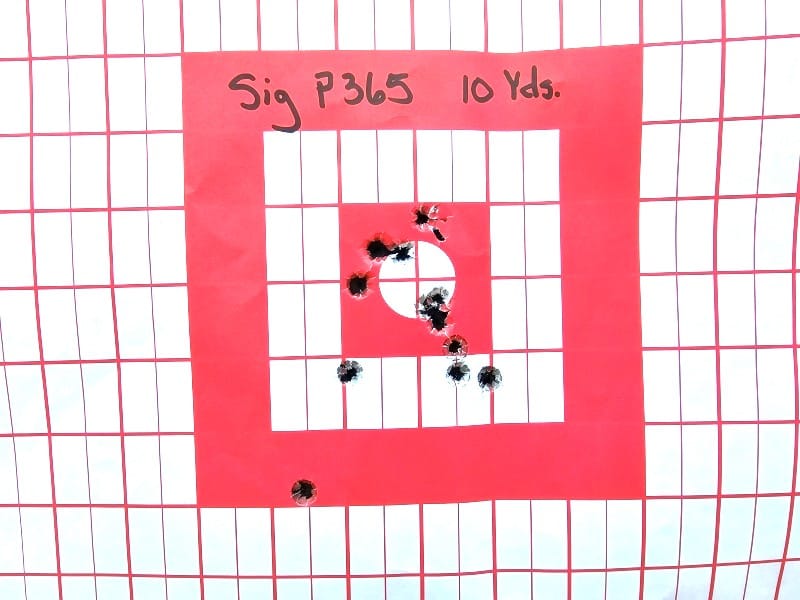
The standard P365 is surprisingly accurate, and the first group that I fired with it at ten yards measured approximately 2.5 inches when fired briskly. Recoil/muzzle flip is certainly there, but it’s not terrible. Compared to some of the other micro-9s on the market, it’s not bad at all. Reliability was, as expected, perfect.
P365XL
We’ll shift gears slightly and take a look at the P365XL. This review will be more brief than that of the P365 because, in many respects, the XL’s traits will be the same or similar to the standard model.

Tech Specs
Sig’s P365XL came on the scene in 2019, a year after the standard P365 was released.
This pistol weighs 20.7 ounces, has an overall length of 6.6 inches and a height of 4.8 inches, a barrel length of 3.7 inches, and a width of 1.1 inches. That extra tenth of an inch is likely because the magazine well flares out slightly; the slide and rest of the pistol are the same as the regular P365.
The XL slide has the same attributes as the standard model, aside from being slightly longer. The sights are also exactly the same. It also shares the same polymer frame design that uses an interchangeable FCU.
Magazines
The P365XL’s standard-capacity magazines are 12-rounders, but the pistol will also accept 15- and 17-round magazines. A nice aspect is that they will also fit in the regular P365.
Grip
The XL’s grip is slightly longer than the regular P365, which simply feels better for me. One might suppose that, with the 12-round magazine and extended base plate in place, the P365’s grip would feel the same as the P365XL. However, this would not be exactly the case, in that the XL’s grip, being one piece, is actually slightly more comfortable. Yes, the P365 with the extensions feels very good, but there are still two pieces with that extension.
Trigger
To me, the P365 XL’s trigger feels the same as the standard P365 (mediocre). However, the XL model uses a straight trigger, which seems to add more control than the P365’s curved trigger.
Controls
The controls on both pistols are the same.
At The Range
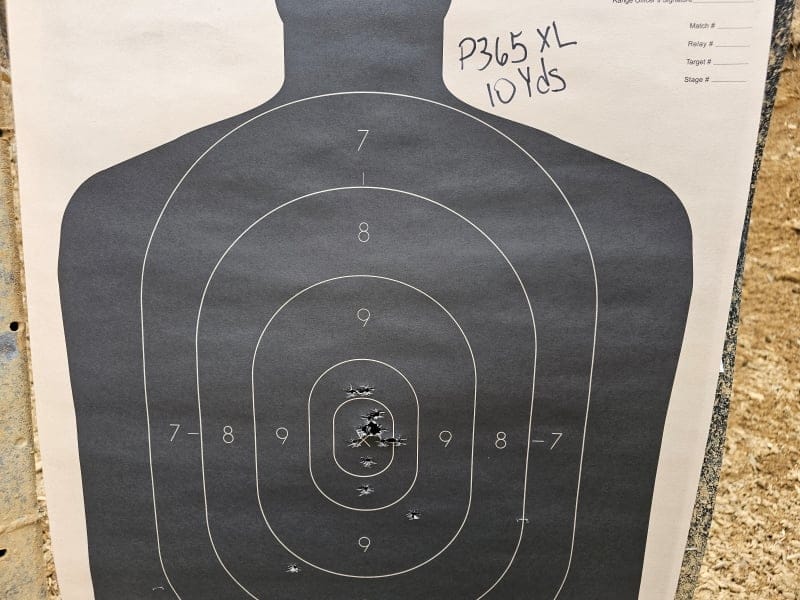
Here’s where things became very interesting. I wasn’t expecting much of a difference between the two, as there is only around a half-inch difference in barrel/slide length. The accuracy of the XL is appreciably better than the P365. I’m not saying it will shoot circles around the smaller pistol, but it’s definitely easier for me to get tighter groups. I actually shoot the XL more accurately than I shoot some service-sized pistols.
To make matters better, the XL has a little less muzzle flip, so the control is better, allowing more accurate rapid fire.
Overall Comparison
So, we’ve established the XL as a more accurate shooter. There is less muzzle flip, so it is more controllable and can be fired slightly faster than the standard P365. The straight trigger of the XL also seems to improve trigger manipulation.
The overall feel of the P365XL makes it seem slightly thinner than the P365, which we know is not the case. However, with its slightly larger dimensions, the XL seems thinner. I’d describe its feel as being more lithe and streamlined than the standard model.
The P365 XL’s grip is more comfortable than the standard model. Even with the magazine extension and 12-round magazine installed in the P365, which makes it the same length as the XL, the XL’s grip is slightly more comfortable.
Overall, I’d say I like the P365XL more because it’s a better shooter than the standard model, and I enjoy that streamlined feel. The standard model P365 does conceal slightly more efficiently, though.
I paid $579 at my local gun shop for the P365XL, so it did cost more than the standard P365.
Is the slightly larger footprint of the P365XL worth the extra size and a couple of ounces? I think it is because of what you’re getting in return as far as controllability and performance/accuracy are concerned. Sig wasn’t trying to simply grab extra dollars out of our pockets, at least, as far as I know, but perhaps there is an underlying motive. They really did give us a better-performing pistol with the XL model.
Is the standard P365 made obsolete by the XL? Not in the least! It will still serve us well, and it is slightly more concealable, so there is that.
Regardless of which model you choose, you’ll be getting a winner. I have both, and I’m extremely glad that I took the plunge and grabbed the XL model while I was at it. It’s a great carry piece!