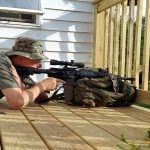

Considering that the Sig P226 competed in trials to become the standard sidearm for the US Military way back in 1984, the design is decades old. We’ve been asked whether or not the P226 design is still relevant today, or is it obsolete and outdated? Sure, it’s a classic, but then, so is the 1903A3 Springfield.
We’re going to dive in and take a look at its capabilities and whether or not it can still hack it after all these years.
Origins
Back in 1984, the US Military was looking for a pistol to replace the 1911, which had served faithfully for over 70 years. We know that the Beretta 92 won the contract, though it was not necessarily due to it being a superior performer. Rather, the deciding factor boiled down to what it usually does in these situations: cost. Beretta managed to beat Sig on the bottom dollar, and so they were chosen.
Despite it not being chosen for general military issue, the P226 exploded on the scene, becoming wildly popular in a few venues.
First, the US Navy SEALs adopted it and used it for years with great satisfaction. That, in itself, is a monumental endorsement. Special Operations routinely has more latitude than the rest of the military in the weaponry that they can acquire.
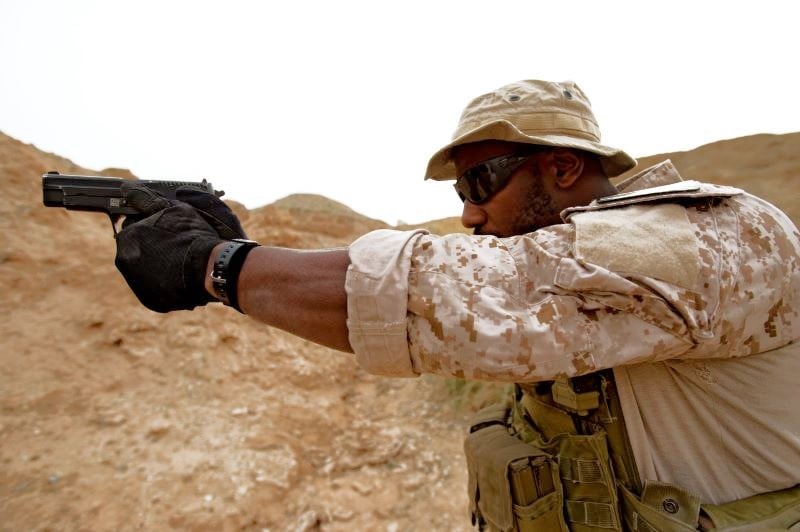
Aside from military use, the civilian market eagerly welcomed the P226. It found its way into the holsters of a huge number of cops in the US. In fact, with many, it became an obsession and a status symbol to have a P226 in one’s holster.
Beyond that, civilians, seeing how the police and the military were embracing the design, flocked to it in droves.
It’s safe to say that a large percentage of “Gun People” simply had to have a Sig in the ’80s and ’90s.
What made the P226 so attractive?
The fact that the SEALs used it was likely a massive shove into the pistol’s orbit of popularity. It’s historically been like that; people find out that the SEALs are using a given item, and people just have to have it. It’s like the ultimate endorsement that a product can get. And let’s face it, the SEALs are just about as cool as it gets, and they typically don’t use junk.
Not that Sig had a shaky reputation prior to all of this. They were always considered to be top-shelf.
Another factor in the Perfect Storm for the P226’s popularity is the fact that we’d just started the massive switchover from wheel guns in the US to autoloaders. People suddenly came to the perception that revolvers left them completely under-gunned and defenseless (not really), and they suddenly “needed” a sidearm that held 15 rounds.
Police agencies started this trend in a sort of “Arms Race” of weaponry. Criminals had turned to weapons that were of higher capacity, and so law enforcement slowly began to accept the idea that maybe they could too. Suddenly, high-capacity autos were in!
And, as we well know, armed citizens often emulate the trends of law enforcement. So it was that people began seriously seeking out auto pistols.
Another aspect during this period of time is that there weren’t a ton of auto pistols out there that were considered supremely reliable; the selection was a bit limited back in those days. The Sig’s stellar reputation for reliability no doubt played a prominent role in citizens’ (as well as the police) desire to adopt the design.
Specifications
Let’s take a look at what the P226 brings to the table, i.e., the technical specifications.
The P226’s weight is a whopping 34 ounces. By today’s standards, that is heavy. Back in the 1980s, it was “normal.”
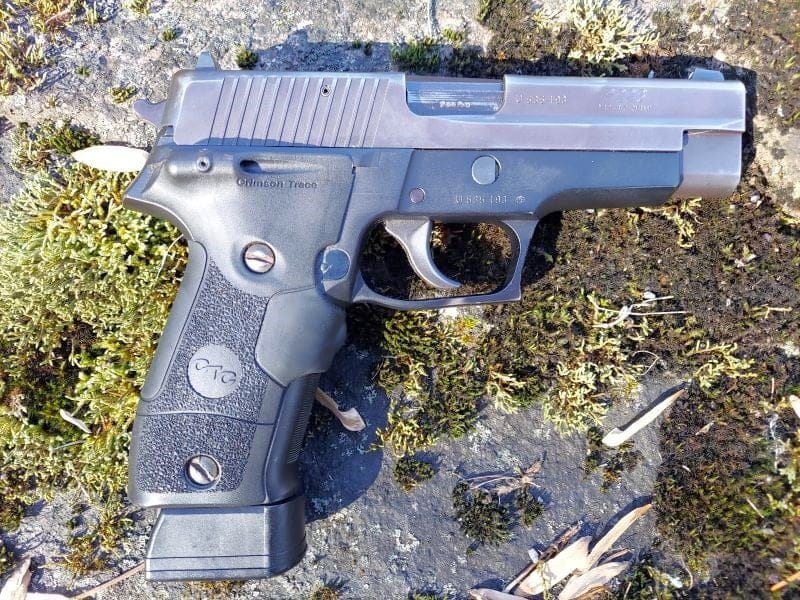
The length of the pistol is 7.7 inches, with a height of 5.5 inches. The barrel length is 4.4 inches. Make no mistake, this baby is full-sized.
The P226 is a Double Action/Single Action (DA/SA) pistol. The first round is fired double action, and single action for the remainder of the magazine after that. There’s a decocking lever on the left side so the hammer can be safely dropped midway through a magazine if the user desires. There are also DAO (Double Action Only) variants of the pistol.

The magazine release is on the left side of the frame, just where we’d expect. Magazines eject very positively.
The capacity of the P226 was originally 15 rounds. 10-round magazines are also available for places that have restrictions. These days, magazines of varying capacities are available for the P226; 10, 15, 20, and 32-round magazines are not unheard of.
Caliber Extravaganza
Back when it came out, we could have the P226 in any caliber we desired, as long as it was 9mmx19 (9mm Parabellum). Other calibers would follow, including .40 Caliber S&W, .357 Sig. Sig has most calibers that people would desire for a defensive pistol in the P226.
Since I’m mentioning variations, there are well over a dozen variations of the Sig P226 on the market. Various finishes, barrel lengths, calibers, and all sorts of neat features have been added. There are far too many to cover in this article but suffice it to say, the P226 is a target-rich candidate in the variant category.
Slides
Prior to 1996, the slides of the P226 were a heavy-gauge, sheet metal stamping that had a welded-on nose section. The breech block was attached by brazing and roll pins. Personally, I like these versions better because, to me, they just look more “classic” because those are the models that I owned.
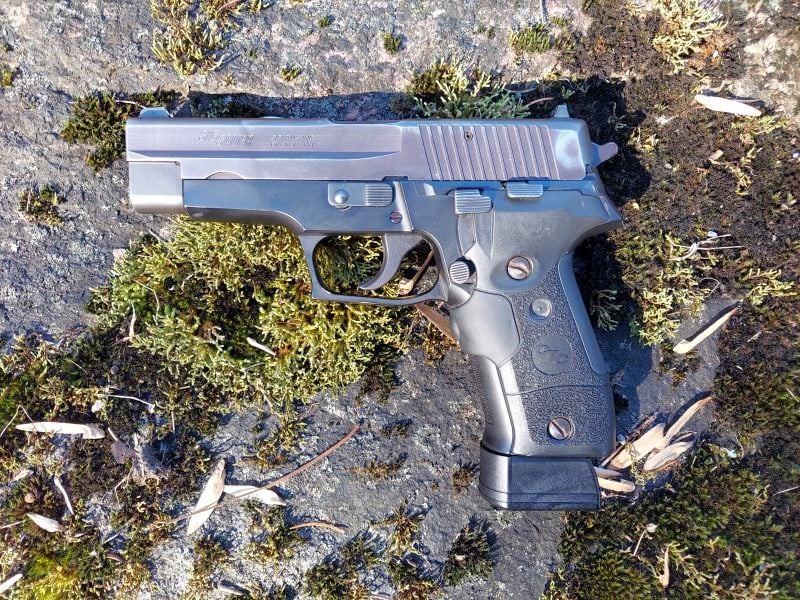
From 1996 on, the slides are machined from one piece of CNC-machined stainless steel. These slides are stronger, and this was necessary because of the higher pressures of the .40 cal. and .357 Sig rounds.
Shooting the P226
I’ll always remember the first time I fired a P226. It belongs to a friend (he still has it). I fired a magazine into the target, and the results made my jaw drop. I could not believe the accuracy! It was the tightest group I’d ever shot from any 9mm pistol in my life! At that instant, I knew that I wanted a P226.
Another memory I have is with my daughter at the range as we fired my P226. It was during a blinding snowstorm with high winds (yes, we were nuts). I scored a magazine full of headshots on a human silhouette target at about 45 yards with that pistol, which astounded me. I felt as though the pistol were nearly firing itself by magic. That’s how good these pistols are.
Because of its size, weight, and efficient recoil spring, the recoil of the P226 is pretty tame. Because of this, the shooter can deliver a high rate of fire on the target accurately.
In all the rounds I’ve ever fired with any Sig pistol (P226, P228, P229, P220), there was never a stoppage or failure to fire. All have been 100% reliable.
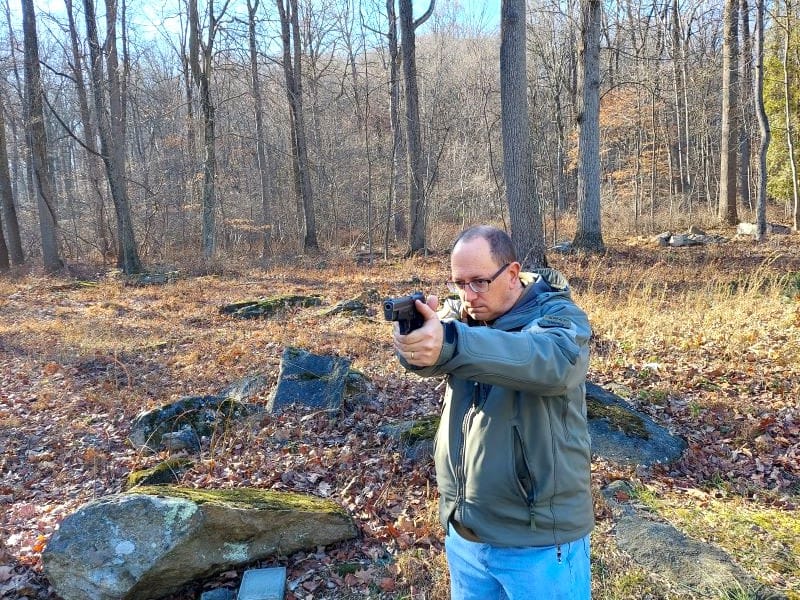
The actions of Sig pistols are, in my experience, buttery smooth. Dropping the slide to chamber a round gives a most satisfying feel and sound; it’s almost like a “whoosh!”
There is the normal transition from double action to single action, which is to be expected. The trigger pull in double action is long but smooth, at around 10 pounds.
Characteristics
I mentioned above that it’s big, and I wasn’t kidding. That largeness is even more apparent these days to those of us who sometimes carry very small, compact pistols. Micro-Compact pistols make the P226 feel all the more massive. Unless we pick up a P226 on a regular basis, we’re likely in for a shock when we do get one in hand.
To be fair, the Sig P226 was not invented to be compact; it’s a service-sized pistol, and that’s how it was intended to be used. Later on, the more compact P228 and P229 versions were released to address concealment issues.
The main factor seems to be that its frame is aluminum alloy compared to the many polymer-framed pistols on the market today. That, combined with its size, makes it heavier than some of today’s service pistols.
Nevertheless, the P226 fills the hand well and inspires confidence. We know we’re holding a serious combat pistol.
In Closing
Is the Sig P226 still up to the task that it was originally created for? I believe it absolutely is! Mind you, it’s not an easily concealable micro pistol like so many of us are used to today. But I think if it were issued to the US armed forces or any police force, they would be well-armed with it.
Yes, it’s heavier than polymer-framed guns these days. However, it just works so reliably and is so accurate that they couldn’t go wrong by issuing these pistols. But then I’m a sucker for “old” designs that still work as well today as the day they rolled off the assembly line.