

Of all the shooting props and tools available to support your firearm, shooting sticks seem to be mentioned the least. Bipods and shooting rests like sandbags are used a lot, but shooting sticks don’t quite get that level of love. Are shooting sticks useful or useless? Are you likely to need them, and if so, why? We think they have some definite uses. Here, we will explain what those are and why you might want a set in your collection of gun-related gear.

What are shooting sticks?
Shooting sticks are fairly self-explanatory, but there is more than one kind of shooting stick. Some are single sticks with a small ledge at one end. Others have two or three legs that can be adjusted at varying angles. The more legs a set of sticks has, the heavier it’s going to be. That also means it’s going to provide a more stable shooting base.
Most shooting sticks have two legs and are unsurprisingly considered bipod shooting sticks. There are also single-legged designs called “monopods” and three-legged designs called “tripods.” The legs of the sticks might be slim enough to bend under pressure. Or they might be thick enough to remain firm. Also, some designs have legs that can be adjusted for height independently. This is great for uneven surfaces. Others have a fixed height or must be adjusted simultaneously. As for the ledge used to support the firearm, sometimes it’s a deep V with padding and ridges for a better grip. Sometimes, it’s a shallower groove. Some designs have one rest attached while others have two—a front and back rest, for superior stability using long guns. As you can see, there are a lot of options.
It’s also worth mentioning that people and manufacturers call shooting sticks by different names. While “shooting sticks” is the most common name, some are marketed as “trigger sticks,” and sometimes you’ll even see a random label like “standing gun rest.”
What are they used for?
The idea behind shooting sticks is to have a piece of gear that isn’t attached to your gun that can be used to provide a more stable platform. That doesn’t mean there aren’t any shooting sticks that can clamp onto your gun; they just aren’t the most common design.
Hunters tend to use shooting sticks quite a bit, but anyone shooting while standing can benefit from a good set of sticks. They can be used for zeroing rifles, precision shooting, or simple target practice. The great thing about them is that they remove the need for a shooting bench. Of course, using them in place of a bench means you’re either going to be sitting or kneeling. There are, however, sticks designed for firing your gun while standing up. And before you get into the mindset that they’re just for rifles and shotguns, shooting sticks can be great for handguns, too.

What kind of shooting sticks work best?
When deciding which sticks are best for you, it’s important to do the usual and think about what you’re doing with them. If you’re going to be hiking into the mountains for a hunt, you probably don’t want bulky shooting sticks. And if you tend to put a fair amount of pressure on them, you don’t want a slender model that’s literally going to buckle under the weight. Figure out if you’re going to need to carry them far. Decide how portable the model has to be, and go from there.
Monopod
Generally speaking, monopod-style shooting sticks offer the least stable platform. It’s certainly a lot better than having nothing at all, but a monopod only offers a single point of contact with the ground and that means it’s prone to moving. When you have a higher number of contact points with the ground, the odds of the platform shifting drops.
Bipod
I’ve found the bipod shooting sticks work great in most situations. You should be able to change the height and angle of the legs individually because it gives you a real edge for stability. After all, you can’t predict what the ground is going to be like, and wasting time trying to find a super-flat spot to shoot from can cost you when hunting. If you really want standing-style sticks, make sure they’re sturdy enough to handle the force of your body leaning into the gun. No, you’re not going to jump up and down on them, but it’s unrealistic to think you’ll stand straight up without putting any pressure on the gun or sticks.
Tripod
If you can carry them around, designs like the Primos Trigger Stick Apex Carbon Fiber Tripod are ideal. They’re impressively rugged and sturdy, and they have one-hand adjustment, which is great for quick setup during a hunt. Versatility is also a thing with these. You can use this tripod for firearms, cameras, or spotting scopes. And because the rest portion of the sticks rotate, you can scan an area, pan the rifle as needed for a good shot, and make any adjustments needed for the best shot possible. Yes, shooting sticks like this Primos model do cost more, but if you’re going to use them a lot, they’re totally worth it.
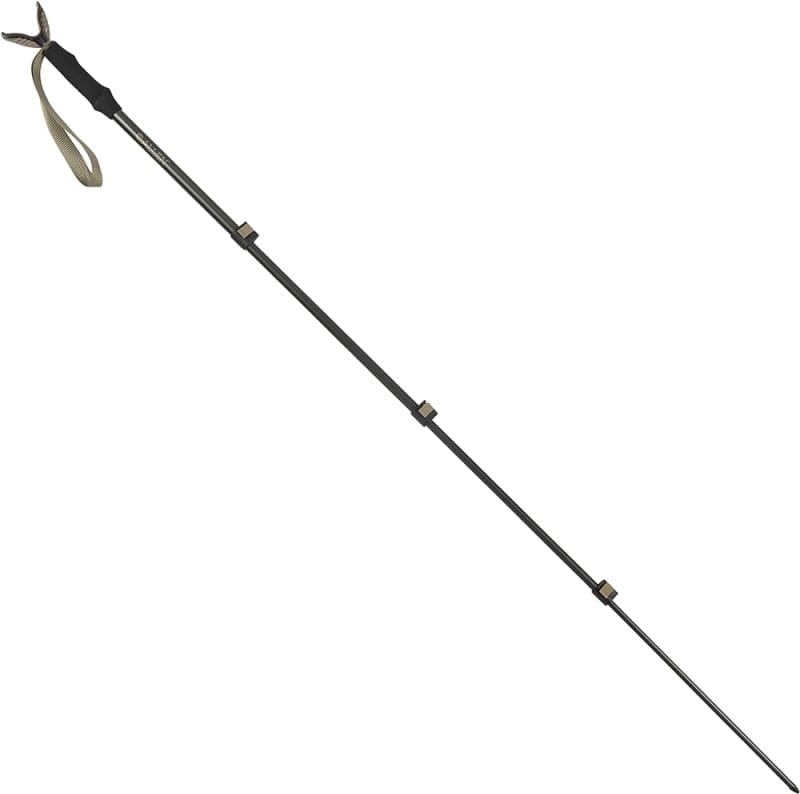
Are monopod shooting sticks ever worth it?
Monopods can come in handy at times. I’ve used them for turkey hunts when I wanted a lighter load of gear and for deer hunts when all I wanted was a little extra support. They do move more, which makes it even more important for your shooting stance to be solid. Finding a monopod that’s thicker is good because it reduces the flexing and motion that’s common to that design. But if you’re looking for reliable stability, you’re not likely to get it with a monopod.
Should you get shooting sticks?
If you spend much time hunting it can be smart to have a set of sticks. Having shooting sticks makes it possible to zero your gun almost anywhere. Don’t assume you’d never need one if you only shoot handguns, either, especially in cases where you’re firing a longer-barreled hunting handgun or bolt pistol.
As for ones that have both a front and back rest, those more elaborate setups are great for zeroing and precision shooting. You’re not likely to ever want to tote them along on a hike or hunt. If you’re just going to be in one spot, they’re fantastic.
