

There it was, lying on a table in a gun shop that I don’t happen to frequent very often. I’d been there only because I was transferring a firearm to a friend; otherwise, I’d have never seen it. I see from the pained look on your face that you’re wondering what “It” is.
Okay, it’s the folding stock from Samson Manufacturing for the Ruger >Mini-14 (and Mini-30), officially designated by the company as the “A-TM” Folding Stock. As I write this, Samson is manufacturing these stocks, and the company has so many orders that it is a bit behind. They’re trying to catch up with all of the orders they’ve received, which is ironic. Why?
When they initially asked Ruger if they could manufacture these stocks, Ruger was hesitant, thinking that there wouldn’t be enough demand on the market to justify the project. Samson persisted and was given the license by Ruger to produce these stocks. As soon as people learned these folding stocks were available, they went nuts ordering them. Orders exploded, and Samson has been going full-bore to fill all the orders.
Consequently, when I saw one of their folding Mini-14 stock lying on a table in a gun shop, just sitting there homeless, my eyes nearly bugged out of my head in disbelief. These things are about as plentiful as an honest politician in Washington right now. But I’m getting ahead of myself. Let’s take a brief look at the Mini-14 before we go any further.
The Mini-14
As best I can gather, Ruger has produced more than three million Mini-14 rifles since it was introduced. Designed by Bill Ruger and L. James Sullivan, it was released in 1973 and outwardly resembles the military’s M-14/M1A rifle. The Mini-14 does utilize a different gas system, though, in that it uses a simplified, fixed piston system. The rotating bolt resembles that of the M1 Garand, M1A, and M1 Carbine.
Many of the parts used to construct the Mini-14 are investment castings, which Ruger is famous for. This rifle is simpler and cheaper to produce than the M1A rifle. It also differs in caliber, being chambered for 5.56mm (and can fire .223 Remington). They also make it in 7.62x39mm, 6.8 SPC, and .300 AAC Blackout.
Beginning in 2005, Ruger revamped its tooling and production procedures to address accuracy issues, which have been fixed now. The weight of most rifles, depending on the stock (synthetic or hardwood), is about seven pounds. Barrel lengths are either 16.12 or 18.5 inches long, and the overall length is around 38 inches.
Folding Stocks
For a few years, back in the late 1980s (and possibly early 1990s), Ruger made a “Factory Folding Stock” like the one Samson is making now. Ruger discontinued selling these folding stocks to the general public in the early 1990s (along with their full-capacity magazines) following a school shooting.
Prices for these stocks went wild on the secondary market since they could no longer be had from the factory. It wasn’t unusual to see them selling (just the stock, mind you) for upwards of $1,000.

Today, Samson uses the same molds and design as the original stocks, and Ruger even supplies the raw hardware, which Samson then finishes and installs.
At SHOT Show 2024, Ruger announced that they are reintroducing their Mini-14 factory folder in a tactical model with a flash suppressor and bayonet lug. Not long ago, I attempted to order one of these rifles through my local gunshop, but they were unable to get one, as Ruger has been sold out, reportedly. Yes, they are selling like hotcakes with no signs of slowing down.
Nostalgia
You may have noticed that Samson’s designation of this stock is the A-TM. Read that as “A-Team,” a popular 1980s TV show in which a band of Special Forces types was branded as criminals and being eternally pursued by the military authorities. While on the run, they find the time to help anyone they run across who is being bullied by bad guys. During the many ensuing gun battles that they engage in, they use stainless Mini-14s with factory folding stocks to spray thousands of rounds from magazines that never run out of ammunition. They always fire from the hip with the stocks folded, and never once was a bad guy hit by gunfire. Perhaps that’s where the Mini-14 got its reputation for poor accuracy.
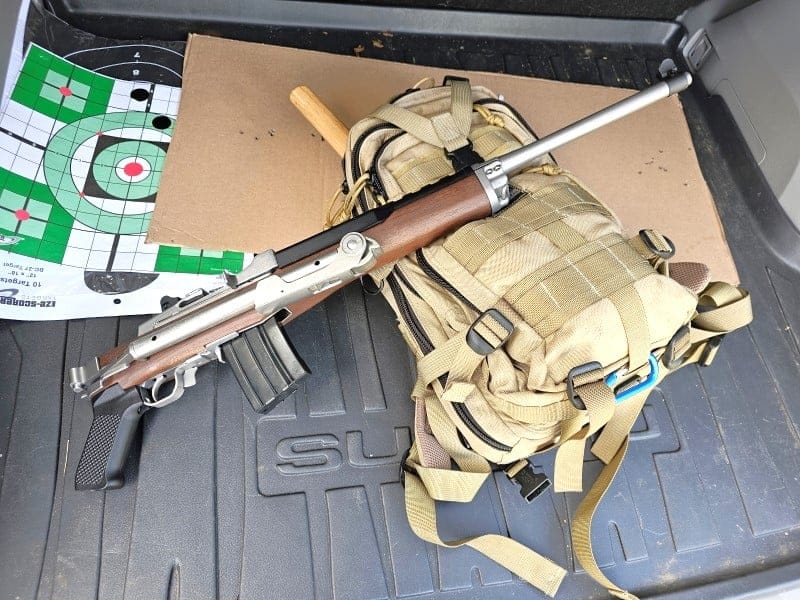
At any rate, many of us simply adore the look of the Mini-14 folding stock for the nostalgia factor. They just look super cool! But is there more to it than just looking cool? Does the folding stock offer any actual benefits?
Practicality
The entire stock, including wood and metal hardware, weighs approximately 2.7 pounds. When extended on a rifle with an 18.5-inch barrel, the overall length is about 38 inches. The length of pull is 13.5 inches, which matches the standard Mini-14 stock.

However, a different factor from the factory standard stock is that the folder is more straight line in configuration, so the recoil goes straight back. This seems to give slightly more control and less muzzle climb than a standard stock.
A practical improvement is that Samson changed the grip material from the original Bakelite used in the ’80s to a more modern and durable polymer. Added durability is always a wonderful thing.
Other Improvements
They also changed the wood. Original Ruger stocks were made from birch, but Samson is now using walnut, which has a darker appearance than the old Ruger stocks. At first, I was disappointed because I really liked the lighter color of the old Ruger stocks. However, the walnut that Samson is using really does have a nice grain that has a charm all its own, and it’s grown on me.
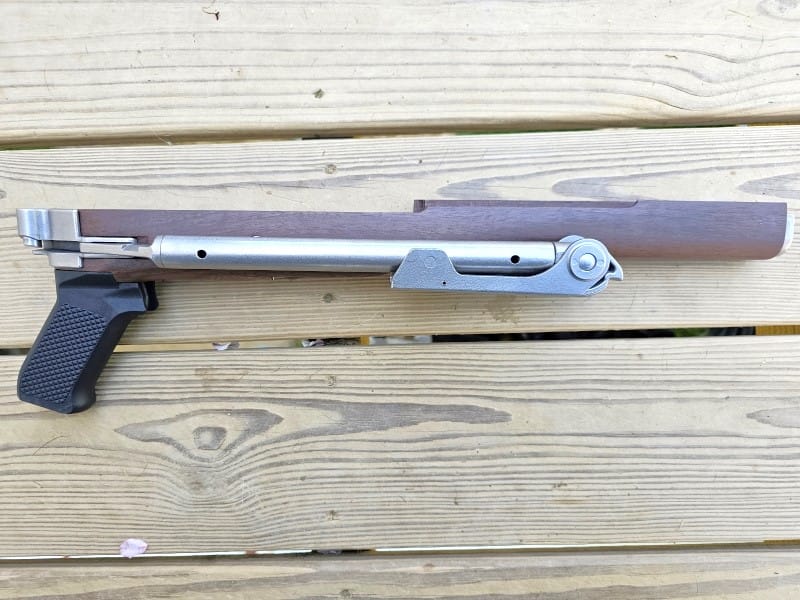
The stock comes packed securely in the box with bubble wrap around the metal arm of the stock so it will not be damaged in transit. The best part is that the entire unit is assembled, and all a user needs to do is remove the trigger assembly and the action of his Mini-14 from the original stock and drop them into the Samson stock. That’s it. The whole process takes mere minutes. These stocks are designed to accept Mini-14 rifles with serial numbers from 181 and newer. I had no trouble installing my rifle into this stock, and I am a mechanical idiot. I did look at the directions and watched a YouTube video beforehand just to see if there were any tricks to it, but it really was that easy and straightforward.
Samson warns against disassembling their stock, as it will void the warranty.
Uses
As mentioned, the straight-line design mitigates muzzle rise. The pistol grip gives slightly better control of the rifle, especially when the shooter is performing magazine changes.
Although it doesn’t look like it would be very comfortable, the metal tube used for the folder is actually pretty comfortable to use. It gives a good cheek weld without being abrasive to the cheek. The balance with the folding stock installed is slightly muzzle-heavy but very comfortable, so I have no complaints about that area.
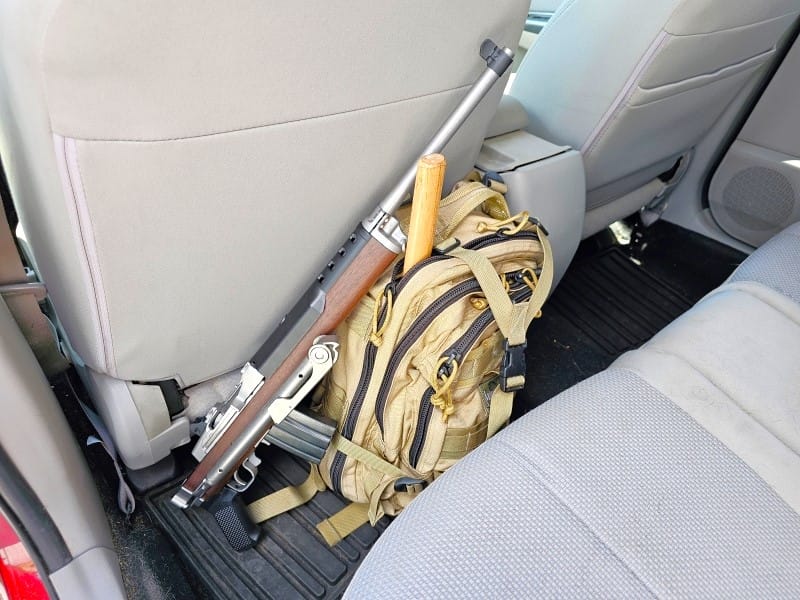
Aside from the comfort factor, the other obvious area where this stock really shines is in its ability to fold up and be stowed in small areas. As a truck/vehicle rifle, this one is awesome.
Operation
The stock is easy to operate, and to open it, one simply pulls down on the metal butt plate, locking it open. The arm of the folder is swung out, and there you have it – it’s fully operational. It takes about two seconds.
To fold it up, there is a button underneath the base of the folding arm that must be pressed to allow the arm to fold. Then there is a recessed lever in the butt plate that must be pulled down (it’s stiff and takes some effort) when the stock meets the tab that sticks out of the side of the wooden forearm. Once the hole in the side of the metal arm meets that tab, you fold the butt plate up, and a recess in the butt plate mates with the tab, locking the contraption in place. It’s actually more complicated to explain than to do, which is a good thing.
Final Thoughts
If you’re on the fence about getting one of these Samson A-TM folding stocks, don’t put it off – get one now. Who knows what the political climate is going to be down the road?
They are an extremely high-quality piece of gear. I compared mine to a Ruger factory folder from long ago, and the quality is comparable. And with Samson’s improvements to the design, I’d say the newer stocks are a little better quality.
These folding stocks enhance shootability and storage options, so the practical advantages are solid. Aside from that, there is the cool factor from the aesthetics that we enjoy so much. These stocks can be had in either a stainless finish to match Ruger’s stainless Mini-14 finish or black. Either way, they’re attractive and function great. Getcha one!