
The concept of pistol caliber carbines had some merit, way back in the 1860s. The same bullet could feed a cowboy’s revolver and rifle. But we’re in the 2020s now. Is the pistol caliber lever gun still relevant? Why would people want to fire a weak pistol bullet through a long gun, isn’t that a waste? Why not just fire a bona fide rifle bullet through a rifle?
It All Started When…
So many of my adventures begin when I’m perusing the shelves in my local gun shop. I’m beginning to think that place is bad for me to go into. My wife might agree with that statement, should someone ask her.
I’d been in the mood—okay, I was obsessed—with finding a lever action carbine with a 16-inch barrel. Not 20 inches, but 16 inches. Specifically.
Why? Because I’d recently checked out my friend’s Marlin Youth .30-30, and that little carbine fit my liking to a tee. Short, light, and easy to maneuver.
And so, that’s why I was haunting every gun shop within driving distance in my quest to find one. Mind you, I’d already exhausted my search on the internet, during which I could not find a SINGLE one in the United States for sale online!
Just a couple short years ago, anyone looking for a lever-action hunting rifle needed only to look at their local gun shop and most of them would have had one or three on their racks at reasonable prices. Not today.
The selection is strained and prices are exorbitant. Almost all of the lever guns that I saw on racks in stores were of the high-end persuasion, with price tags to match. I’ll be honest, I didn’t have a minimum of $1,000 to drop on a rifle at the time. Many were even pricier than that.
Finally!
Suddenly, everything clicked when I saw it on the shelf—a Rossi R92 lever action. Although I’d been after something in .30-30, this one was in .357 Magnum. Considering the drought of short lever actions available, it didn’t take long for me to snatch it off the shelf. Destiny dictated that it was coming home with me.
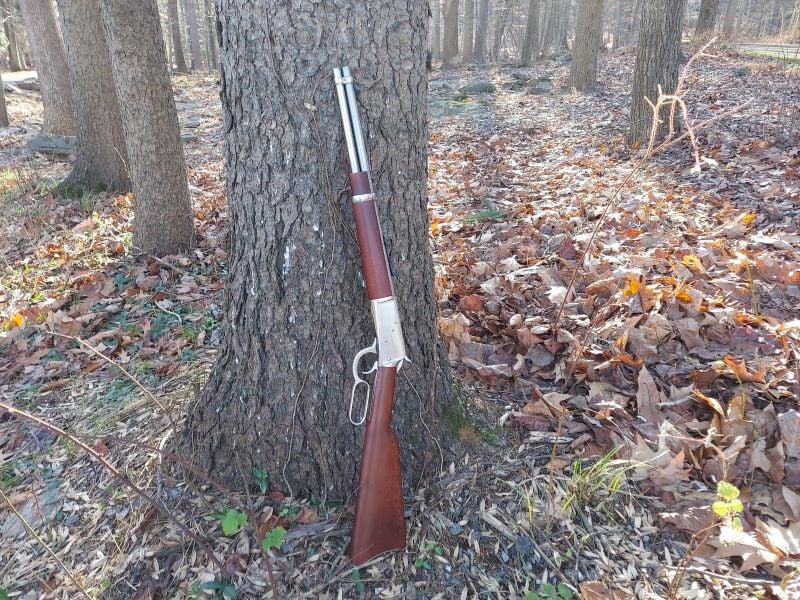
Lest readers think I might have been a little too hasty in choosing this lever gun, I’d flirted with the idea of a .357 or .44 Magnum for several years, but I’d never gotten around to it until this time. It was a dream that was in the works for several years, and it had finally come to fruition.
Pistol Rounds — Really?
Anyone familiar with my writings knows up front that I repeatedly state that pistols are sadly lacking when it comes to stopping bad guys. It’s a fact. So why would I, or anyone, select a handgun caliber to run through a long gun? Well, there are several attributes.
- Increased velocity.
- Low recoil.
- Low muzzle blast.
- Less expensive ammunition.
From pistol barrels, the bullets move slowly, but when fired from a rifle-length barrel, hundreds of feet of velocity are routinely added to the bullet. We’ll look a little more closely at that in a bit. Just know that adding velocity of that magnitude drastically increases terminal effectiveness. Terminal ballistics is how the bullets act inside the target.
As I get older, I enjoy sharp recoil less and less. The .357 Magnum gives very little recoil in this 16-inch barreled carbine. When firing .38 Special rounds through it, it felt as though I was firing a .22 Long Rifle, literally.
The muzzle blast is minuscule with this carbine, even with the Magnum loads. For home defense or firing inside enclosed spaces, that is a major boon. If you’ve ever fired from inside a vehicle or building, you know what I’m talking about.
As I write this, rifle ammo is locally very expensive. Hunting-type rounds are running between $20 and $45 per box of 20 in most places. My local shop has .357 Magnum for $36 for a box of 50. It’s cheaper than rifle ammo.
The Magnum
The .357 Magnum needs no introduction. Its powers as a man-stopper are legendary, even from handguns. Let’s take a quick look at the Magnum’s ballistics from both short and long barrels. I picked a smattering of loads just to give an overview.
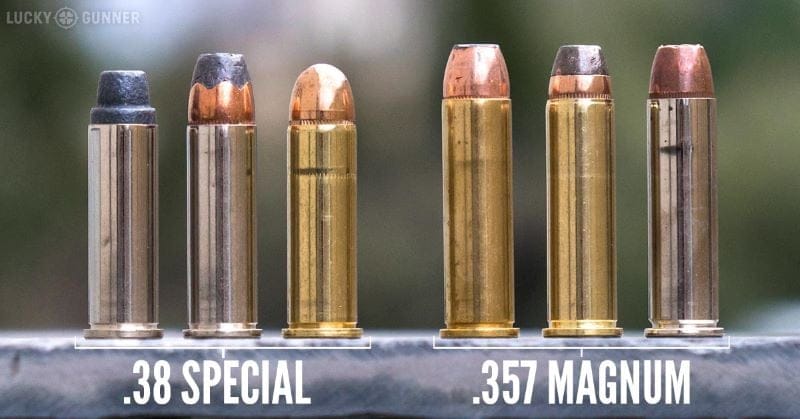
These velocities are courtesy of Ballistics By The Inch (BBTI).
The following loads are from four-inch barrels, representative of service-sized revolvers:
- Cor Bon 110 Gr. JHP: 1,286 FPS.
- Cor Bon 125 Gr. JHP: 1,496 FPS.
- Federal 125 Gr. JHP: 1,511 FPS.
- Federal 158 Gr. JHP: 1,293 FPS.
- Federal 158 Gr. Hydra-Shok JHP: 1,332 FPS.
Here are the same loads from a 16-inch barrel:
- Cor Bon 110 Gr. JHP: 1,790 FPS.
- Cor Bon 125 Gr. JHP: 2,119 FPS.
- Federal 125 Gr. JHP: 2,051 FPS.
- Federal 158 Gr. JHP: 1,739 FPS.
- Federal 158 Gr. Hydra-Shok JHP: 1,741 FPS.
We can see that the 16-inch barrel adds 400-500 feet per second to the velocities of these rounds. A couple of them exceed 2,000 feet per second. At that speed, organs and tissues are damaged even if the bullet does not hit them. The bullet merely passing close to organs will impart enough disruption to damage organs.
.38 Special
Next, we’ll take a look at the .38 Special and do a few comparisons…
These are .38 Special loads from two-inch barrels. Why did I choose the two-inch barrel for the .38? Because so many people these days stuff their snubby revolvers with the .38 Special, and it seems more common than the four-inch barreled offerings:
- Cor Bon 110 Gr. JHP: 675 FPS.
- Cor Bon 125 Gr. JHP: 723 FPS.
- Cor Bon 110 Gr. DPX: 814 FPS.
- Federal 125 Gr. Hydra-Shok JHP: 700 FPS.
- Speer Gold Dot 135 Gr. JHP: 756 FPS.
From the 16-inch barreled Rossi:
- Cor Bon 110 Gr. JHP: 1,298 FPS.
- Cor Bon 125 Gr. JHP: 1,261 FPS.
- Cor Bon 110 Gr. DPX: 1,388 FPS.
- Federal 125 Gr. Hydra-Shok JHP: 1,252 FPS.
- Speer Gold Dot 135 Gr. JHP: 1,315 FPS.
Again, with the .38 Special, we’re seeing some dramatic increases. Granted, the velocities of the two-inch barrel are pretty unimpressive. And even in the 16-inch barrel, they’re not shooting like a death ray. Still, the velocities achieved are nothing to sneeze at.
Diminishing Returns
There comes a point of diminishing returns. I’d assumed that adding two more inches with an 18-inch barrel would add more velocity, but I was wrong. That extra two inches actually causes projectiles to begin slowing down. Apparently, the powder stops burning and the friction of the barrel begins slowing the bullet down. This would be even more pronounced with a 20-inch barrel. Many shooters believe that the longer the barrel, the higher the velocity. As we see, this is not always the case. With these cartridges, 16-inch barrels are the sweet spot.
Firepower
My 16-inch barreled Rossi holds eight rounds of .357. In this day and age of 30-round magazines, that might seem paltry to the tactical crowd.
If you’re among those who consider the lever action for defensive use, you’ve likely taken a hard look at what mission you want that carbine to fulfill. We really need to do an honest assessment when choosing any weapon system. Realistically, how many threats do we expect to need to engage with our lever gun? Do we want it to repel home invaders? To deal with a riot situation? Civil unrest?

Eight rounds of .357 Magnum is going to be sufficient medicine for quite a few potential problems. Realistically, do we expect to go into a full-blown combat situation with the lever gun? Most likely not.
Handling
These little lever guns are lightweight and fast handling, which makes them favorites of many shooters. With practice, the actions can be worked quickly, engaging targets in short order.
For this reason, no small number of people have chosen the lever action as their “truck gun”, a term that has gained popularity in the past few years. These slim carbines easily fit behind the seat of your favorite vehicle to be accessed if needed. They’re just plain handy to have around!
Nostalgia
For the same reason that many of us enjoy classic military arms, there are those who simply love the nostalgia of the old Cowboy Gun. Seeing one harkens us back to the days of John Wayne, Wagon Train, Clint Eastwood, and Chuck Connors as The Rifleman. There’s no denying the prominent place that the lever action has cemented in our uniquely American history.
Fun
The pistol caliber lever guns are just plain fun to shoot! That low recoil is a real winner in the fun department. Cowboy Action Shooters have been using them for years. Some of those guys have achieved a phenomenal level of skill with their arms, and the courses of fire are fun to watch. This is definitely a growing sport in America.

Legalities
In some places, people are restricted from owning semi-automatic firearms. It’s unfortunate, but it is a facet of reality that we have to acknowledge. Do those folks have to be under-gunned? If they have access to a lever action, they don’t have to be.
Considering the lever action’s place in Americana, it tends not to get people overly alarmed when they see one. Especially when compared to any of the popular Black Rifles these days. People see us with an AR-15 or AK-47 and many become alarmed, but when they see someone with a lever gun, they think, “Oh, that’s just a hunting rifle.”
If we’re ever in the terrible position where we have to use deadly force to protect ourselves and our loved ones, we will look a lot more reasonable in court if we used a lever gun. Using an AR-15 might be construed as though we were just looking for the opportunity to gun down those poor home invaders. A lever action suggests that, hey, we’re a normal, average Joe just trying to protect our family.
The courtroom is often all about appearances. Don’t believe me? Look up some court cases and see for yourself.
Is it worth it?
I believe going with a pistol caliber in a lever action definitely has its advantages. While they won’t reach out as far as rifle calibers, the pistol rounds do have their advantages. Less recoil and muzzle blast are attractive attributes, especially as we grow older. Less cost for ammunition is another great aspect.
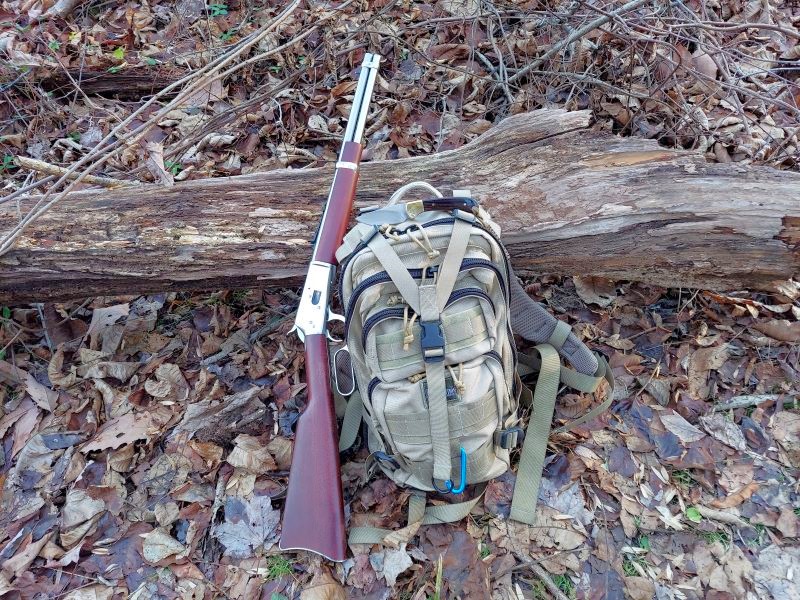
Nostalgia draws still more people in, reliving pleasant memories, and the little lever gun covers a lot of bases from hunting and recreation to competition and defense.
Yes, it’s fair to say that lever actions have their following, and that’s not likely to change any time soon. Regardless of the reasons that we’re attracted to them, they are all valid.