

Pistol caliber carbines (PCCs) have always been an interest of mine. While limited in terminal performance and range compared to a rifle carbine, PCCs maintain a popular following today. With options like the CZ Scorpion, B&T APC9, Ruger PC9, and many others; the options are plentiful.
PCCs are nothing new. Considering the submachine guns of yesteryear, such as the M3 Grease Gun, Sterling and Sten submachine guns, and numerous others; PCCs and their variants have been around for a minute and many appear obsolete. Over the years, I’ve fed my interest in pistol caliber carbines through acquiring some of the notable makes and models of past and present. One of those is the Uzi submachine gun, specifically the semi-automatic variant, the Model A. Since its acquisition, I’ve sought to update this design, more than 70 years old, into a modern pistol caliber carbine.
The Uzi Model A
The Uzi Model A was originally designed by Uziel “Uzi” Galil in the late 1940s and entered service with the Israeli military in the early to mid-50s. Since then, the Uzi has become a recognizable staple of film and firearms lore. Import of the Uzi into the United States was facilitated by Action Arms beginning with the Model A around 1980. Originally an open bolt machine gun, the Uzi Model A removed the open bolt feature and integrated a striker design on the firing pin to convert the firearm into a closed bolt semi-automatic.
One of the more interesting features of the Model A is its telescoping bolt design. This design allows the bolt to envelope over the barrel inside the action. As a result, the bolt weight is distributed partially over the barrel and isn’t entirely behind the breech-face.
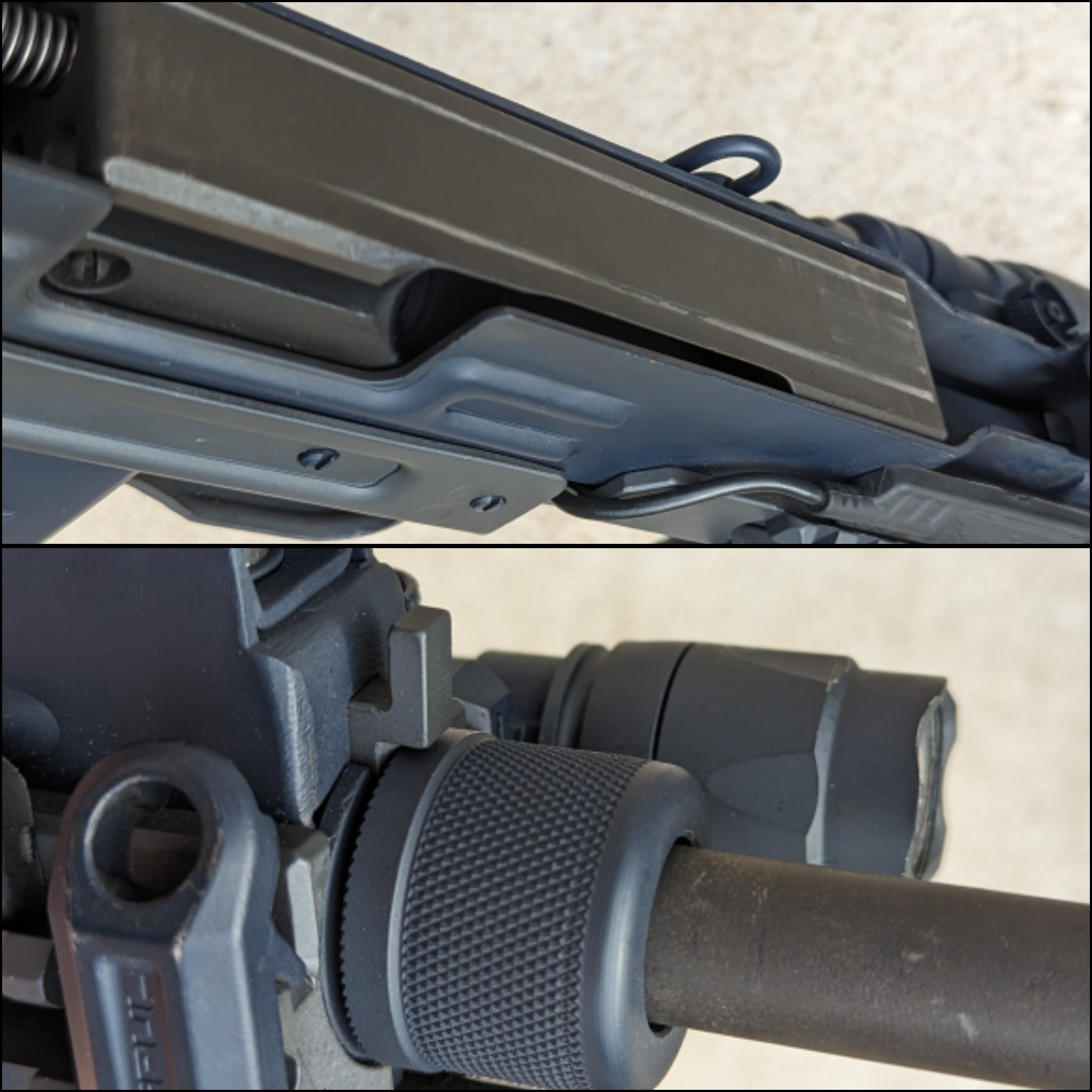
The Uzi is an exceptionally modular design. The top cover is easily removed to access the bolt assembly whereas the barrel is held in place by a nut locked in place by a spring-loaded detent. The original Action Arms imports had options for four calibers: .41 Action Express, .22 Long Rifle, 9mm, and .45 ACP. Caliber changes are accomplished in seconds and with relative ease.
The firearm has two external safeties: a grip safety near the rear and a selector switch on the left side of the grip. While designed around a right-handed shooter, the safety selector is easily manipulated for wrong-handed folks like me. While on the topic of convenience for left and right-handed shooters, the charging handle is non-reciprocating and located on the action’s top cover. The charging handle is convenient for left and right-handed shooters alike.
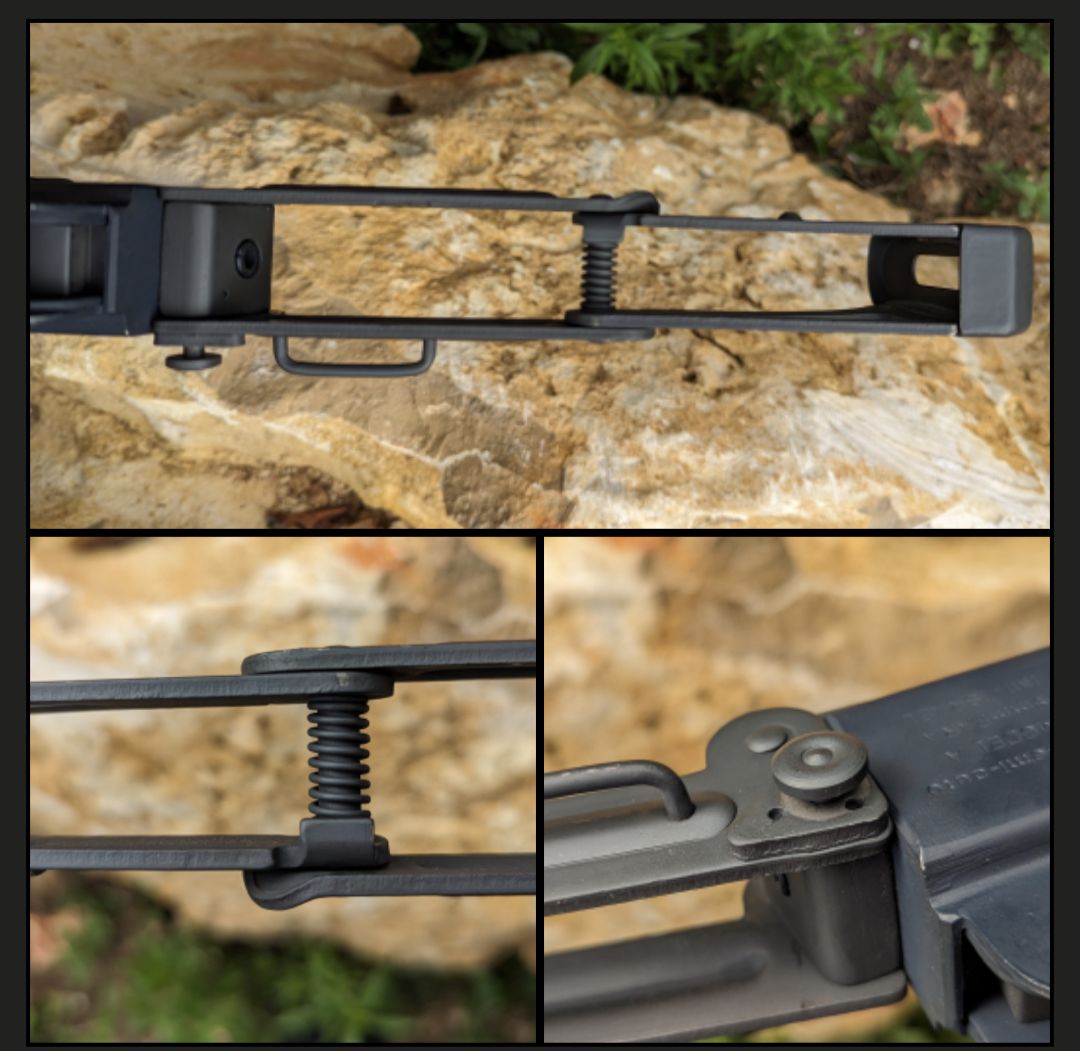
The stock folds into the rear of the action at two hinge points: a push button at the rear of the action releases the stock while pushing the furthest bar of the stock inward releases the second hinge to securely fold underneath the action.
Compared to many other pistol caliber carbines, the Uzi feels awkward and heavy. For example, the KelTec Sub2000 carbine weighs around four pounds and the HK MP5 weighs around 5½ pounds. The increased weight of the Uzi makes for exceptionally soft recoil on a direct blowback firearm. Comparably, the KeltTec Sub2000’s recoil impulse is significantly more pronounced from my experience.
Modernizing a 70-year-old Design
I have a bit of a soft spot for the Uzi. When I purchased mine nearly 10 years ago, I had 1,000 rounds of the inexpensive Russian 9mm steel case sitting around and decided to run the weapon through a torture test. After burning through those 1,000 rounds, I experienced approximately 12 malfunctions. Those malfunctions carried a caveat though — the primers were put in backward at the factory and were never going to work. If that’s any indication of the quality of ammo being used, one can imagine how dirty it was.
After burning through those thousand rounds, I put another 250 rounds of Winchester white box 9mm through the gun before it finally malfunctioned. The action was so filthy the feed ramp on the chamber was caked with powder residue and grime. The gun was simply too dirty to function and could no longer reliably feed a cartridge. After a quick cleaning, the Uzi was back up and running. After such an impressive performance, I decided to update the rifle to a modern fighting pistol caliber carbine.
This Uzi was outfitted with the original 16” carbine barrel it shipped with in 1982 and was equipped with three caliber conversion kits in .22 LR, 9mm, and .45 ACP. After some paperwork to the ATF, the rifle became a little more…compact and capable of accepting a suppressor.
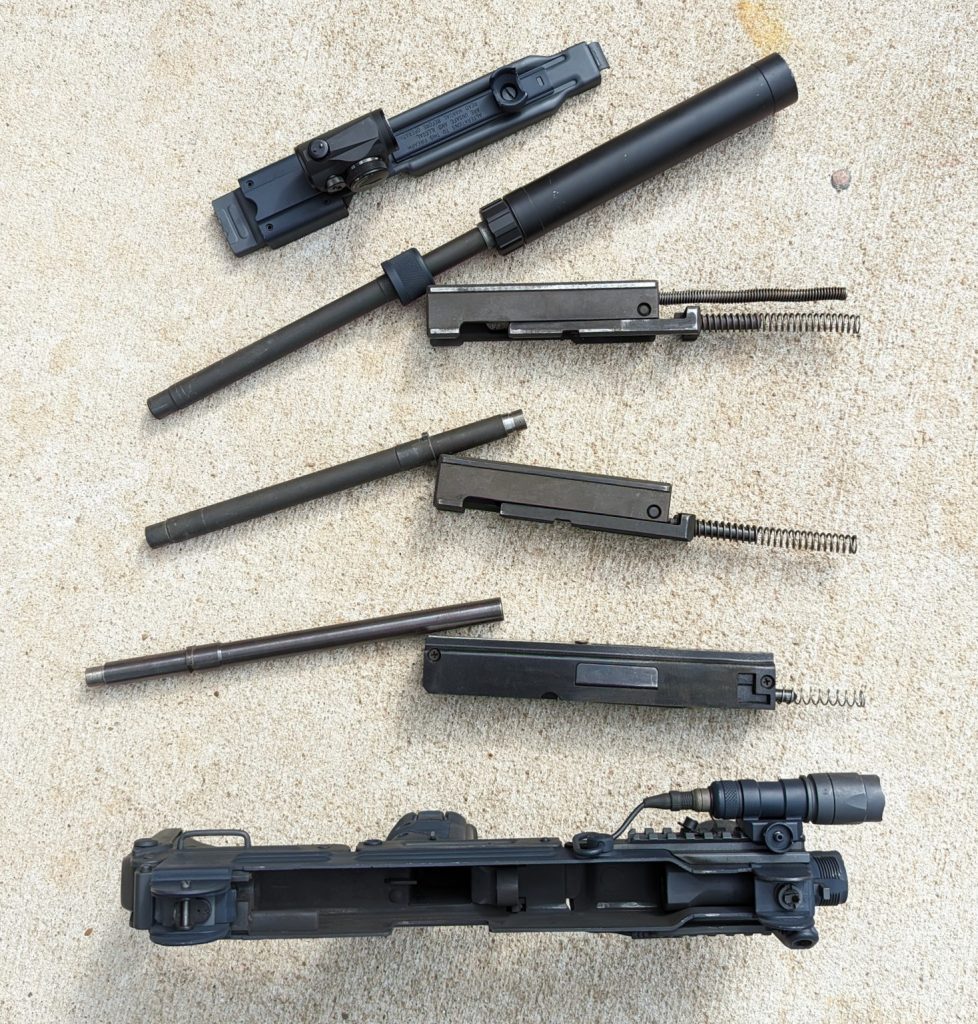
The original Action Arms import had an available Weaver mount for optics. While not conducive for a scope, it allowed for the easy mounting of a small optic to the weapon — an Aimpoint H1 for this setup.
No modern fighting carbine is complete unless the handguard has some kind of mounting surface for M-Lok, KeyMod, or Picatinny rails. After some research, the FAB-Defense tri-rail came us a convenient update to the original plastic handguard of the Uzi. A Magpul vertical foregrip and Surefire Scout Light were added to round out the ergonomics and low-light capabilities of this pistol carbine.
In my opinion, sling attachment points are one of the biggest pitfalls of the original design of the Model A. While sling attachment points were conveniently included for right-hand shooters, lefties were…left out. A QD attachment point was added to the rail and the right-hand stock sling attachment was easily adapted for use as a two-point sling. Ultimately, a unique blue and gray Cerakote paint scheme from Cave State Customs gave the Uzi a modern flash on a 70-year-old design.
Shooting and Handling
This particular Uzi spent most of its life in a safe prior to coming into my collection. Since then, it’s been run through several pistol caliber carbine courses. Most folks who get their hands on the Uzi for the first time complain about its weight — until they shoot it. Once rounds are downrange, the complaints stop. While heavy for a pistol caliber carbine, this PCC is relatively well-balanced and compact. For a straight blowback firearm, the heavier bolt makes for exceptionally soft recoil.

The second complaint many shooters have is the cheek weld on the stock. The thin metal on the stock is not necessarily preferable but I’ve grown accustomed to shooting it. With the pleasant recoil, running this setup through a multi-day class with 1,000 rounds down range isn’t as miserable or unpleasant as some would assume.
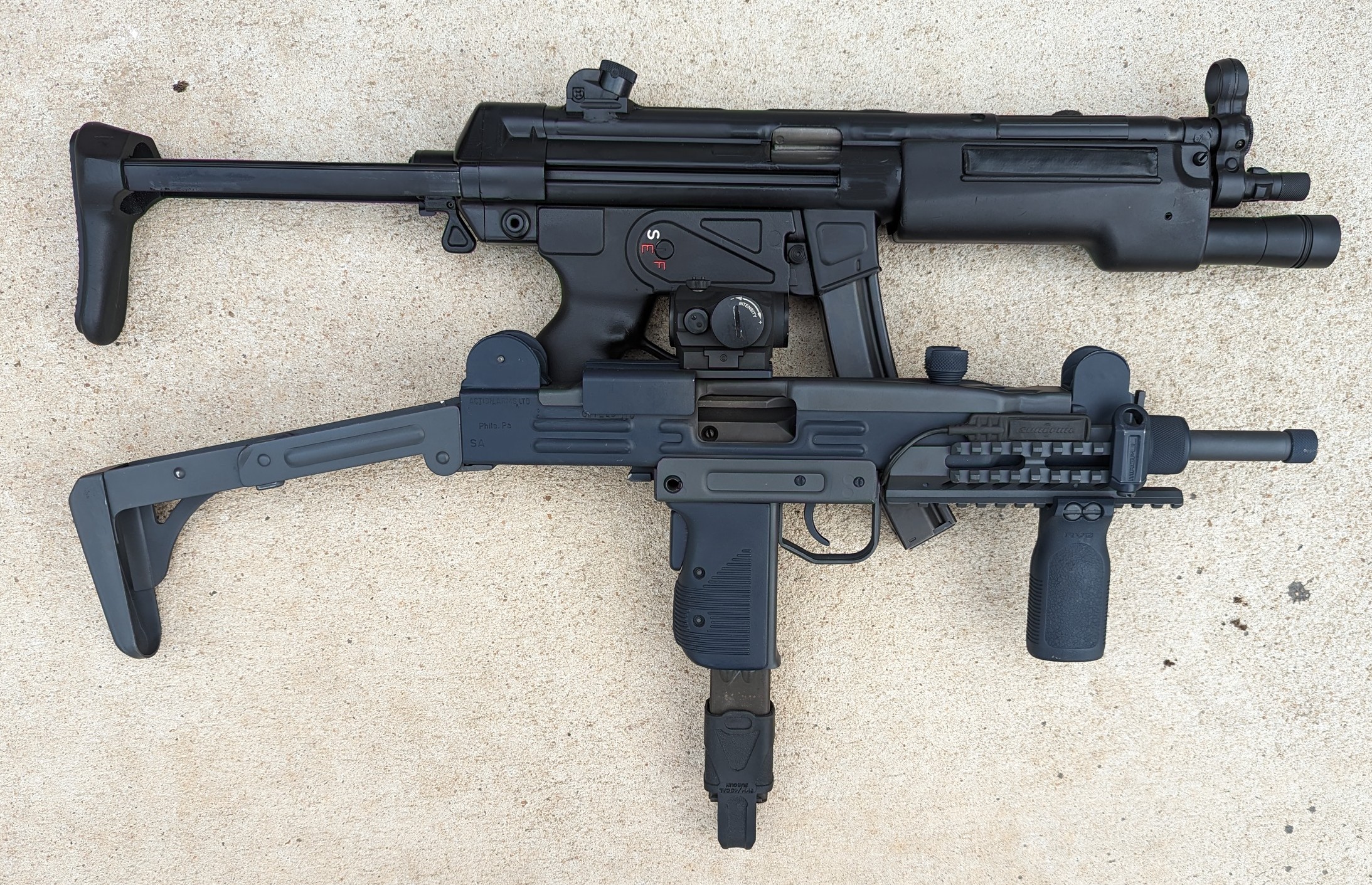
In direct comparison with one of the more legendary pistol caliber carbines, the Uzi isn’t any bigger than an HK MP5A3, but does carry an extra two pounds compared to the MP5. The MP5’s roller-delayed action allows it to have less weight with a similar soft recoil to the Uzi.
Compared to other pistol caliber carbines on the market, it’s hard to find a setup that is as modular as the Uzi. The ability to switch calibers quickly and easily is a tremendous benefit. When demonstrating suppressor performance on the AAC Ti-Rant .45 suppressor, the Uzi is my go-to because the clanking of the bolt is louder than the shot itself. Every shot generates a slight giggle from the shooter at how quiet the rifle is with subsonic .45 exiting the suppressor.
The Uzi Model A is a classic firearm that catches up with the times with easy upgrades. However, this firearm isn’t realistic for everyone’s budget (original Action Arms imports sell for thousands of dollars depending on accessories) nor is it the ideal pistol caliber carbine. Regardless, it’s a fun and interesting piece of historical nostalgia that makes for great training and a fun range day. It’s not the age of the weapon but the willingness to train and learn the semantics of that platform that makes it functional and practical. Some just look cooler than others in the end.
