
If you run optics on pistols or defensive rifles, you’ve probably heard the term “co-witness.” You’ve also probably heard it broken down into absolute co-witness and lower third co-witness. Finally, if you pay attention, you’ve seen the pros and cons of both. But does it really matter which method you choose, or do you even have to choose? Let’s talk about it.
What is Co-Witness?
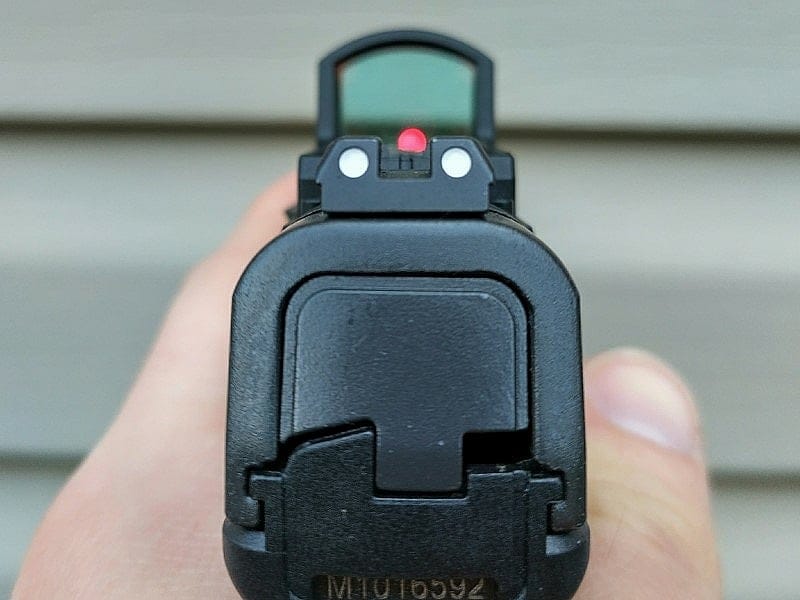
Just in case you haven’t read those articles or watched those videos, the term co-witness refers to aligning your electronic sights and iron sights so that you can run either or both. It’s really that simple. The details emerge when you start deciding how to accomplish that. Or you may just run one or the other, which is perfectly fine. Those people do exist since not every gun owner is OCD or feels the need to incorporate every latest thing on their guns.
I fall in between, having not one, but two optics on my number one AR-15. The fact that I have a “number one” of any rifle shows that I can be a geek about such things. But…’Murica. That AR does not have iron sights for the simple reason that I don’t have rail space for a rear sight and my offset is occupied by a red dot. On the other hand, I still haven’t bought into optic-equipped handguns. I just don’t like them. I may or may not come around one day. We’ll see.
My dislike of handgun optics and an extra rifle optic mean that I don’t need to co-witness anything on that rifle or any of my handguns. So, why write this article? First, I was asked to. Second, I do have co-witnessed sights on my beloved AK-103 and my son has optics on two handguns, being wired a bit differently than the old man. So, the question becomes absolute co-witness or lower third? To me, and this is my article, the answer is “yes.”
Pick What Works
That answer probably seems like a cop-out. But let me explain. When the gun bug bit me about a dozen years ago, I devoured every bit of info I could, trying to learn the “best” way to do things. After all, guns and accessories ain’t cheap and I wanted to spend my money wisely.

What I learned was that there are often several “best” choices and sometimes one way of doing something works just as well as another. What you hear depends on who you’re listening to at the moment. I’ve now reached the point where some people (some, not many) ask my opinion on guns and gun-related topics. After many years of searching for the “best” thing, my answer is almost always, “It depends,” closely followed by a question about what that person wants to accomplish. Call it a cop-out if you want. I call it being honest after listening to too many people tell me I should do what they do because everything else is wrong.
But if you’re going to choose, you need to understand the choices, so here we go.
Absolute Co-Witness
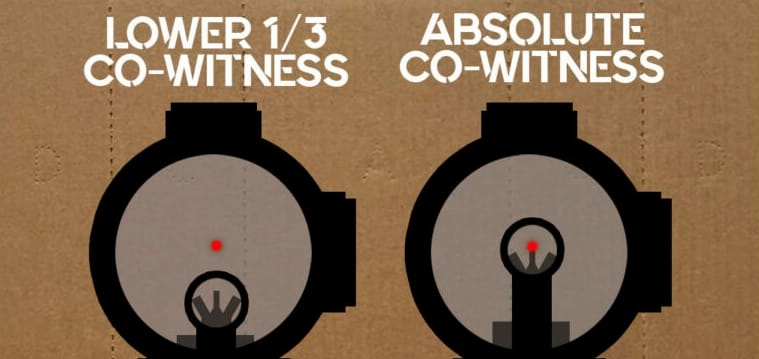
Absolute co-witness simply refers to your optic and irons being directly aligned. If you look through your optic and your dot or reticle rests right at the top of your front sight post, you have an absolute co-witness.
When I ran flip-up irons on my AR, I had them set up like this. I did that because an absolute co-witness meant that my cheek weld stayed the same, no matter which sights I used. A lower third co-witness forces me to adjust my cheek weld. More on that in a moment. It also meant that both sights, electronic and iron, had to be zeroed the same. But that’s not hard. Just zero the irons first, dial in your optic, and confirm the zero. You may have to fiddle with it a bit while paying attention to your cheek weld.
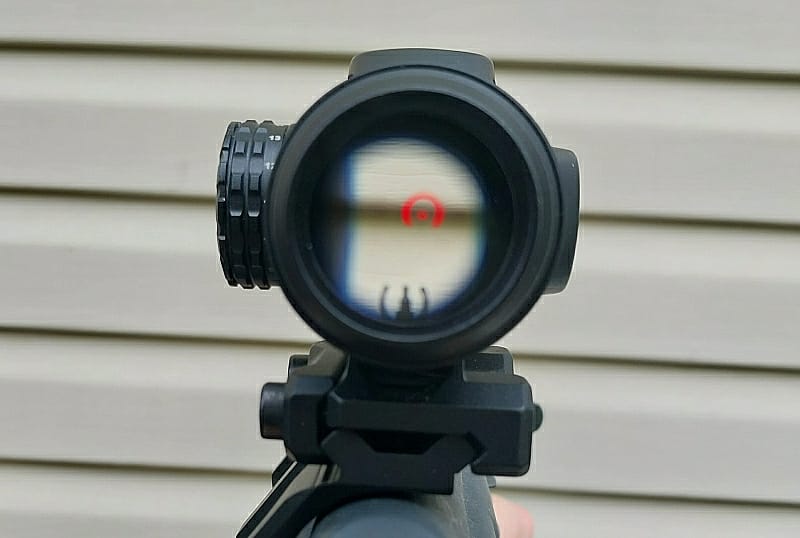
If I ever go back to flip up sights, I’ll do it the same way. I should note that most, if not all flip-up AR sights are designed for absolute co-witness, so there’s that. And because I’ve committed to a 1-8x LPVO rifle scope as my primary optic, I will want flip up irons. I don’t want a fixed front post cluttering up my field of view. Also, my LPVO’s eye relief is less forgiving than an ordinary 1x red dot. That makes it more important than ever that my cheek weld is the same every time.
Keep in mind that the dot may not always be perfectly aligned on the front post. Sometimes it may appear a bit off. Once you’re zeroed, this is usually a cheek weld issue. If you have doubts, get your cheek weld right and confirm your zero.
Likewise, my son uses absolute co-witness on his handguns. That makes sense to me. Pushing out and presenting a handgun so that you pick up the front sight every time is a training issue. An absolute co-witness means you have the same presentation, even if your dot fails.
So, does all that mean lower third co-witness isn’t as good? Nope. Let’s talk about that.
Lower Third Co-Witness
The primary advantage of lower third co-witness is that there isn’t as much going on in your optic picture. That’s because, as the name implies, the top of your iron sight is sitting down in the lower part of your optic window. Your dot or reticle will hover above it, free and clear. An absolute co-witness means that more of the iron is in your line of sight, perhaps negating some of your optic’s advantages.
The trade-off, as we noted, is that you probably need to train more to use optics and irons effectively. Now, this can be as innocuous as lowering your cheek weld to engage the irons. It’s not really an issue if you practice. With handguns, a lower third co-witness means your presentation angle will differ. Personally, I’m not a fan since getting your presentation down is hard enough without having to learn it two ways. But you do you.

Some firearms, however, don’t give you a choice. My AK-103, for example. The AK’s fixed sights, combined with the optic mounting system, require a lower third co-witness for me. That’s the case for most AKs. I say most because I’m sure someone has figured out an absolute setup of which I am unaware. But with mine, I can either do a lower-third co-witness or go without an optic.
Honestly, I’m comfortable either way, but my eyes aren’t what they used to be, so I found an optic that works for me. I’ve mitigated the difference between my absolute co-witnessed AR-15 and my lower third co-witnessed AK-103 by installing a low magnification (3x) optic with a very forgiving eye relief on the latter. That way, I can easily adjust my cheek weld without seeing a tube full of black when I try to acquire the irons. A simple 1x red dot would work fine too, but like I said, my eyes aren’t great these days and I want some magnification. Honestly, my eyes may yet force me to adopt handgun optics.
Zeroing isn’t a big deal here, either. I just turn off the optic and zero the irons through the optic window. I then zero the optic as I normally would. It’s not hard, assuming you know how to zero your sights.
One Last Thing: Mounting Height
Optic mounts come in different heights, as you’re probably aware. I can’t give you much hard and fast information about which to use. I can, however, say that a 0.83-inch riser mount provides absolute co-witness for standard AR-15 height iron sights. A one-inch riser mount will give you a lower third co-witness for the same sights.
BUT…there are shorter mounts that will also give you a lower third co-witness. And understand that this varies across platforms. I can’t tell you exactly what mounts will give you what you want. My advice, as always, is do your homework. If I’m looking at a product from which I want a particular result, I find out whether it can deliver. If that means I have to call the company to ask them directly, then that’s what happens. Most are happy to help you. If not, go somewhere else.
Neither is Wrong
As I explained, I have reasons for my AR and AK setups. My son has reasons for his handgun setups. We chose them because they work for us. With the AK, I didn’t have a choice of co-witness, but I did have a choice about how I approached it.
No one knows your needs better than you. Not me. Not anyone else. I can offer what I do and, more importantly, why I do it. If that helps you, even if it makes you think “that’s stupid,” that’s great. That means I’m doing my job.
The important part is that you find what works for you. Lower third? Fantastic. Absolute? Awesome. Does it depend on the gun? Sweet. As long as you know what you’re getting into, and train for it, then you’re good either way.