

Most people know about and recognize the seemingly ubiquitous AR-15. But have you ever wondered about the history of the AR-15’s big brother, the AR-10? Who designed it, and what prompted that design? We’ll answer those questions and more today. Read on to find out the origins of this influential firearm.
World War II Influence
During World War II, the Germans designed some innovative and unique weapons that were ahead of their time. Even today, we can see the traits of some of these weapons in current designs. One specific trait that stands out is the straight-line stock design. We can see it in the MG-34 and MG-42, which were their General Purpose Machine Guns throughout the war. Another weapon was the FG-42, designated the “Paratrooper Rifle,” chambering a full-size rifle caliber (8mm Mauser) and capable of firing fully or semi-automatic.
The straight-line design of these weapons, and many that came after them, directs recoil straight back to the shooter. This design is superior to the traditional stocks because it reduces muzzle rise, keeping the weapons more on target. In short, the weapon is easier to control, and follow-up shots are faster.
After the war, the nations of the newly-formed NATO (North Atlantic Treaty Organization) wanted to conduct trials to develop a standardized rifle for use by their forces. Submissions included the T48, which was also known as the FAL, and Springfield Armory’s T44, which later became the M14. Germany also had their excellent G3.
The Armalite AR-10
Enter Armalite, which happened to be an engineering subsidiary of Fairchild Engine and Airplane Corporation, based in Hollywood, California. There were nine people on staff, including Eugene Stoner, who was the chief designer.
The new rifle introduced by Stoner and his team was called the AR-10. The initial design was completed in 1955, chambered for the 7.62x51mm NATO round, which was specified by NATO. Basically, it was the .308 Winchester commercial cartridge.
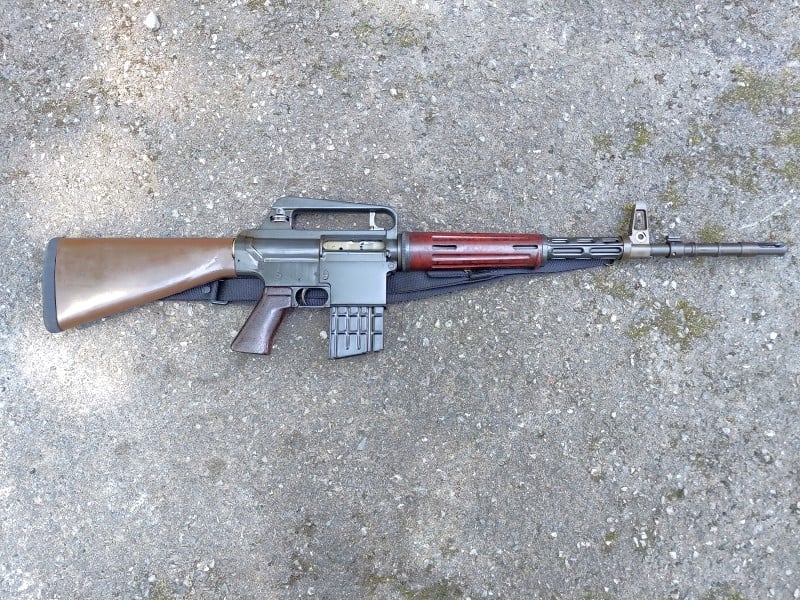
The AR-10 was approximately one pound lighter than most other infantry rifles of its time because it utilized an aluminum alloy receiver, along with reinforced fiberglass stock, handguard, and pistol grip. It has some other features that set it apart, as well, such as the aforementioned straight-line stock. Elevated sights and a recoil compensator were also included.
Stoner also included a new, patented gas system in the AR-10. Gas from a fired round would be directed through a gas block in the front sight assembly, and through a small gas port in the barrel. The gas would continue to travel down a metal tube back to the receiver and into a gas key on the bolt carrier. The gas pushed the carrier back, which unlocked the bolt from the barrel extension. Then the bolt group extracted and ejected the empty casing from the chamber. The bolt group then recoiled into the buffer spring in the stock and rebounded. On its way forward, it stripped a fresh round from the magazine and chambered it. At this point, the weapon was ready to fire again.
Barrel Explosion
Armalite’s president, George Sullivan, specified that a composite barrel made of aluminum and steel be used in the AR-10. Unfortunately, during a torture test conducted by Springfield Armory in 1957, the barrel burst. Despite quickly replacing the barrel with an all-steel version, Springfield Armory refused to recommend the AR-10 for adoption. They claimed it would take at least five years of testing before they’d be able to recommend the weapon for adoption.
It strikes me as curious, and likely a conflict of interest with this because Springfield Armory was fielding its own design, the M14. This was an easy way for Springfield Armory to knock out a competitor in favor of their own rifle. It seems to have worked.
Based on all of this, the Army decided that the AR-10 was too prototypical for adoption without further extensive testing, and so the AR-10 was out. And Springfield Armory’s M14 was in. In retrospect, to be completely honest, it appears that the AR-10 was far ahead of its time, which could have had something to do with its rejection.
Not All Was Lost
Despite the NATO failure, Armalite licensed the AR-10 to several nations and arms manufacturers. These included the Dutch group Artillerie Inricthingen (AI), and it saw service in Portugal, Cuba, Burma, Italy, Guatemala, and other places.
If at first, you don’t succeed…
The failure of the AR-10 wasn’t going to stop Stoner and crew from pursuing success.
In 1957, there was the US Continental Army Command rifle program, the goal of which was to develop a .22 caliber, selective-fire rifle weighing less than six pounds and being capable of accuracy out to 500 yards. Stoner joined forces with Bob Fremont and Jim Sullivan to bring back the basic AR-10 design. In 1958, Armalite introduced the AR-15 rifle, chambered in .223 Remington.
In 1959, Armalite sold the AR-15 and AR-10 designs to Colt because there were no military buyers. In time, Colt’s M16 rifle became the main service rifle for the US military. Since Vietnam, it has been our nation’s primary issued rifle in one form or another.
AR-10 Specs
Depending upon the configuration, the specifications on the AR-10 vary a little bit, but we can easily list some general specs for you to get an idea about the rifle.
- Weight: 7.25 – 8.9 pounds
- Length: 41.3 inches
- Barrel: 20.8 inches
- Caliber: .308/7.62×51 NATO, 6.5 Creedmoor
- Feed: 20-Round box magazine
- Operation: Gas, direct impingement
Modern AR-10 Manufacturers
Nowadays, there are a slew of gun makers manufacturing AR-10 type rifles: DPMS, Palmetto State Armory, Smith & Wesson, and others. It seems that many people enjoy having a .308 caliber AR-15, and companies are obliging. As an example, Springfield Armory has a version called the Saint Victor, chambered in .308, weighing 7.8 pounds with a 16-inch barrel. Armalite has a 16-inch barreled Defensive Sporting Rifle that looks similar to an M4 carbine. Basically, it’s an AR-10 carbine in .308.
Rifles such as these have all the latest bells and whistles of the current industry. Handguards, stocks, sights, scopes, flash hiders that accept suppressors… you name it, the AR-10 has come into the 21st century in a huge way. Every accessory that you can bolt onto the AR-15 can also be attached to the AR-10.
The Rifle
The example I used for this article belongs to a good friend. It was made for use by a foreign government. When that country discontinued using the platform, it was imported into the United States.
This particular rifle features the old-style fiberglass stock, handguard, and pistol grip. I found the fiberglass furniture to be a very cool, retro aspect to this rifle. And this stuff is truly lightweight! Just like the early M-16 rifles, this one feels sort of like a “Mattel Toy,” although it’s a little heftier than the original M-16.

The rear sight assembly is very simple, and resembles the sights on the M16A2, in that there is a horizontal wheel for adjusting the elevation. Adjustments are numbered one through five for the distance the rifle is being shot at. It is of the aperture (peep) type.
The front sight is familiar, being the same as the ones we’re familiar with on the M-16 family; a sight post with two curved ears on both sides. All in all, the sights are great.
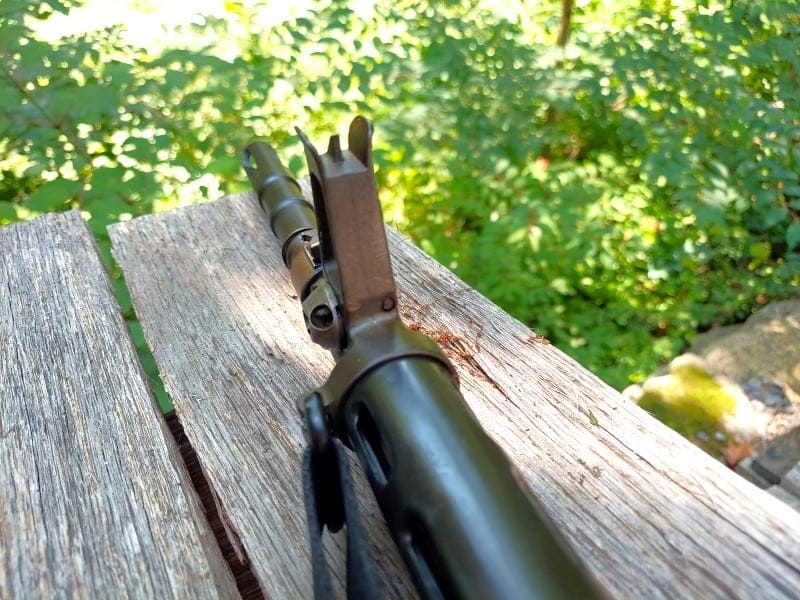
All controls are essentially identical to the AR-15 that we’re so familiar with. Which is to say, they are as close to perfection on a rifle as humanly possible. The safety/selector switch is easy to manipulate with the thumb. The magazine release can be quickly and easily activated with the index finger of the firing hand.
The AR-10 at the Range
Enough with the history and tech specs. What is the AR-10 like at the range? Darn fun!

Recoil is mild, best described as a gentle push, and not sharp at all. Given the straight-line design, the push travels straight back into the shoulder, which makes follow-up shots very rapid.
We didn’t test for groups, but shot 10-inch steel discs at 100 yards. It was child’s play to ring them time after time, and the rifle can undoubtedly do this well past the 100-yard mark.
As far as 7.62mm rifles go, this one is a real winner. Both fun and accurate, it gives full-power battle rifle performance.
AR-10 Magazines
Fortunately, the AR-10 platform is popular enough that there are lots of magazines out there. GunMag Warehouse has a pile of magazines from Armalite, ranging from 5-round to 25-round capacities.
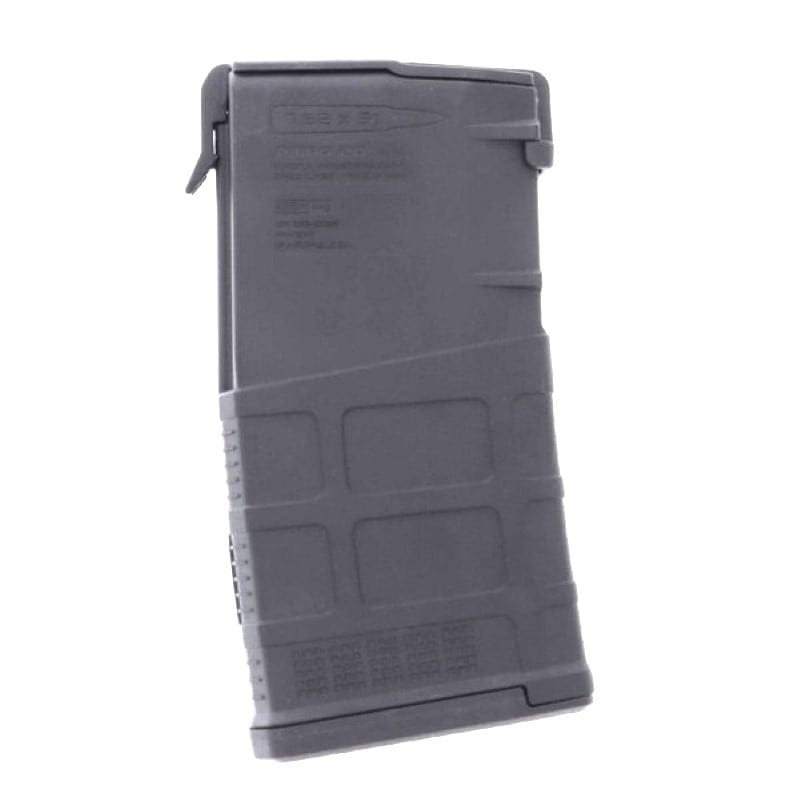
Magpul AR-10 magazines are also plentiful in today’s market. Magpul is widely known for their high quality and durability. Hexmag also jumped into the AR-10 game with excellent magazines of their own.
All of these magazines are very reasonably priced and of high quality, so there’s no excuse not to have a pile of spare magazines on hand. On top of that, there are a ton of aftermarket accessories that will work on the AR-10 platform.
In Closing
Similar to the AR-15, the AR-10 has been soldiering on since the 1950s. The original design was sound then, and it is still just as sound today, with a lot to offer the modern-day rifleman, considering that the market has kept up with modern advances. Whether you’re after a rifle for defense, target shooting, hunting, competition, or just plain old fun, the AR-10 fills the bill very well. It’s nice to see that companies realize the platform’s popularity and have kept pace as far as magazines and accessories are concerned.
If you get a chance to put some rounds down range with an AR-10, I recommend jumping at the chance. It’s as good now as it was back in the 1950s!