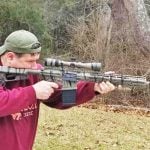

AR vs AK. It’s the eternal question. Unless you’re brand new to the gun world, you’re probably as sick of it as I am. If you are brand new, welcome. If you hang around long enough, you’ll be sick of it too. But there was a time when I gobbled up the debate, trying to figure out where my hard-earned dollars would be best spent. I eventually learned that the correct answer to which is better is “Yes,” tempered with a healthy dose of “It depends.”

So, with that in mind, let’s look at one guy’s experience owning both platforms and talk about a recent range trip where the two went head-to-head. This was not a scientific experiment. Many variables were left unaccounted for because I don’t check barometric pressure and all that stuff when I’m on the range with either rifle. I’m not that kind of shooter. There are also other variables which are impossible to reconcile. We’ll get to that. But we can get an indication of how each performed on the same task.
AR vs AK: The Contenders
In the AR-15 corner, we have my Grey Ghost Precision Mk II Light, better known as “Eowyn.” Yes, I’m one of those geeks who names his guns. Some of them, anyway. Eowyn is a better-than-mil-spec M-4 clone chambered in 5.56 NATO. She has a 1:7 twist rate, 14.5-inch barrel and sports a pinned and welded Grey Ghost Precision 4-port brake. I’ve owned this rifle since 2017 and have many, many rounds through her. I don’t even know how many.
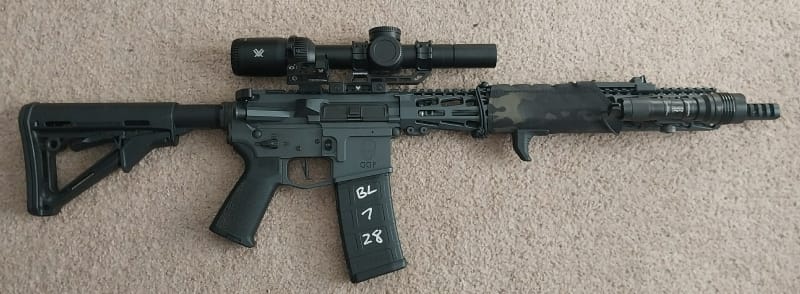
Eowyn currently wears a Vortex Strike Eagle 1-8 FFP LVPO rifle scope and a Vortex Venom Red Dot offset at not quite 45°. I will note that my rifle is not exactly in spec with the current Grey Ghost Mk II Light rifles. It was actually a MK II Light prototype that I managed to purchase because I knew a guy. Same quality, but with a few differences.
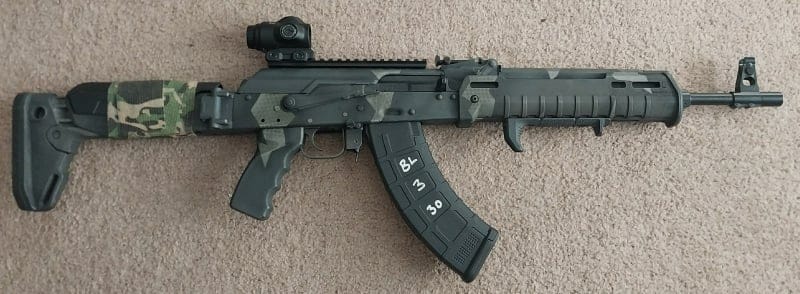
And in the AK corner is my Saiga AK-103 conversion, AKA “Roza,” chambered in 7.62×39. I stripped off the cheap furniture she came with and replaced it with a Magpul Zhukov folding stock and handguard. The chrome-lined barrel measures 415 millimeters, which translates to 16.3386 inches in God’s measuring system. I’m not positive about the twist rate. Kalashnikov Group lists it as “240,” whatever that means. I translate it as “rifle is fine.” Honestly, it’s probably one twist every 240 mm, which ciphers out to a 1:9.44819-inch twist rate. That tracks with Roza’s general accuracy, but “rifle is fine” works for me. Roza has no muzzle device at this time, though she’s slated for a flash hider when I get around to it.
I’ve owned Roza since 2013. Like with Eowyn, I don’t know how many thousands of rounds she’s put downrange. It’s a lot. Roza currently sports a Primary Arms SLx 3x Micro Prism optic optimized for 7.62×39 and .300 Blackout. Roza was built in Russia by Izhmash, on the same production lines that make Russian military AKs. She was one of the last rifles to be imported before the ban on Russian weapons. The quality is there.
The Shooters
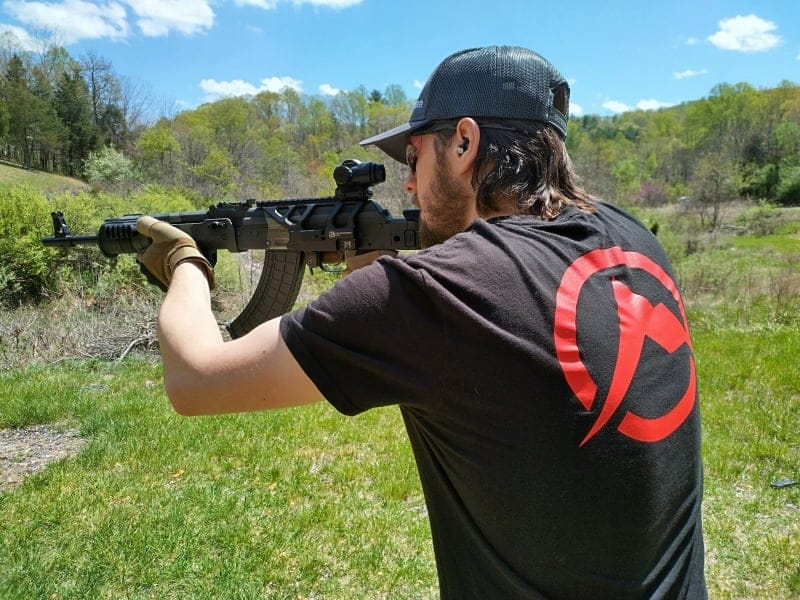
The shooters for this friendly competition were me and my son, Will. We both have lots of time on these rifles, but for this one, I had the AR and Will had the AK. Despite owning several ARs between us, we both drill with Roza too. We are about equal in terms of skill. Each rifle was equipped as noted above.
Ammo-wise, I was shooting American-made PMC X-Tac 62-grain M855 5.56 NATO. Will had Russian made Wolf 122-grain steel-cased FMJ. So, each rifle had rounds from its country of origin, not that it matters.
AR vs AK: Built-In Disparities
If you’re paying attention, you’re likely getting the idea that ARs and AKs are like the proverbial apples and oranges. If so, congratulations. Welcome to the world of St. Eugene vs. St. Mikhail (peace be upon them). If not, let’s try a little harder to convince you.
Different Platforms with Different Philosophies
ARs and AKs have different design parameters and different manufacturing tolerances. Tighter tolerances in your average AR-15 mean that it’s generally more accurate than your average AK. The AK was purposely designed with looser tolerances to provide greater reliability in the field. Remember, the Soviets were only a few years out of World War II when they accepted the AK-47 for service. They had learned that reliability in all conditions was paramount. The same requirement influenced the gun’s simple, yet effective, design. That simplicity means it can only be fine-tuned so much, even in high-end AKs.
Plus, Soviet manufacturing capabilities were not equal to American industry when the AR-15 was designed a decade later. Even recently manufactured AKs, like Roza, are built on that same philosophy, even though the manufacturing technology has greatly improved. That’s just the AK system and you know what they say about fixing things that ain’t broke.
The AR-15, while not a precision weapon by any means, is still more so than the AK. That’s just how it was designed. It reflects a different philosophy in terms of an American military, and an outdoor tradition, that has always valued accurate rifle fire. The American experience is different from the Soviets and weapon designs reflect that.
Finally, the two rifles have completely different operating systems. The AR-15 is a direct impingement system, using the gas to directly operate the bolt. The AK does it with a gas-driven piston. They both work.
Ammunition
The ammunition is obviously not the same. The Soviet 7.62×39 round is bigger and hits harder than the American 5.56×45. The 5.56, on the other hand, is faster and more accurate. But that’s not the point. Each cartridge, like each rifle, speaks to the philosophical priorities of each nation.
The Soviets developed the 7.62×39 round for the SKS rifle in the mid-1940s. Mikhail Kalashnikov was required to fit his design to that cartridge. It’s effective and it fits the WWII Soviet philosophy of “good enough,” while still being easy to mass produce. And mass produce it they did, and still do. That’s why 7.62×39 is relatively inexpensive. That availability and price point are why I chose that chambering instead of the more accurate, but more expensive, 5.45×39 cartridge the Soviets developed for the AK-74.
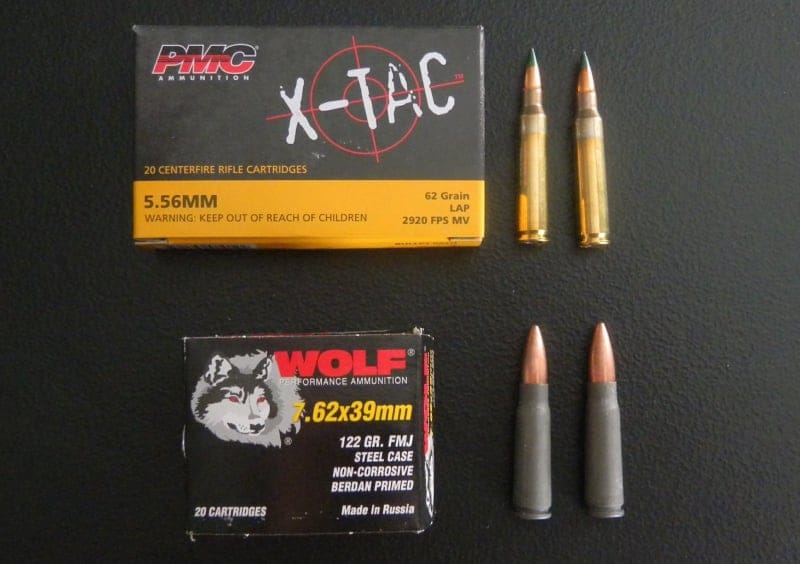
Additionally, in this case, I used brass-cased American mil-spec ammo, while Will used the cheapest steel-cased 7.62×39 that I could find. As noted, the 5.56 NATO round is generally more accurate than the 7.62×39, especially when the latter is the cheap stuff. I could buy more expensive brass-cased ammo, but here in the real world, I can stack the cheap stuff high for not a lot of money and my AK eats it and spits it out just fine. It’s “good enough” for what I want it for. So, this friendly competition is less scientific, but more realistic because each rifle uses ammo that most owners of both guns are more likely to use every day. Or however often they shoot.
Finally, the 7.62×39 recoils a bit more heavily than the 5.56. It doesn’t kick like a mule or anything, but the heavier recoil does impact accuracy and the ability to bring the rifle back on target. This is amplified by design differences regarding the AR-15’s buffer spring and the AK’s recoil spring, which mounts on the bolt carrier. The AR’s buffer spring absorbs more recoil.
The Rifle Setups
We said that the 7.62×39 kicks a little harder than 5.56, but these rifles are also set up differently, impacting how the shooter deals with recoil. Eowyn, my AR, has a very effective Grey Ghost Precision muzzle brake that eliminates almost all muzzle rise. I’ve never used a centerfire rifle that’s so easy to keep on target for follow-ups.
Roza, on the other hand, has no muzzle device at all. Will not only dealt with slightly heavier recoil, but he also had more muzzle rise, impacting his ability to stay on target from round to round.
The Optics
Another difference, though not a huge difference maker, is optics. With the AR-15, I used a 1x red dot coupled with an LPVO. Will, with the AK-103, had a single fixed magnification optic. I don’t think it made much difference, if any, because I had the LPVO set between 3x and 4x, while Will’s was fixed at 3x. The only real difference that I can see is my transitioning between optics as we moved from close range to medium range targets. And that’s a choice on my part.
Shooters
Finally, using two shooters adds another variable. We possess similar skills, but there are endless small things that could affect such a competition. So, not using the same shooter for both rifles adds some disparity one way or the other.
Shop This Article
-
Duramag Speed AR-15 .223, 5.56mm, .300 Blackout 30-Round Aluminum Magazine - Olive Drab Green
 $19.99$13.99Save $6.00
 -
Lancer L5 Gen 2 AR-15 .223 / 5.56 30-Round Advanced Warfighter Magazine - FDE
$21.99$15.99Save $6.00


AR vs AK: The Competition
This wasn’t anything fancy and, like I said, far from scientific. But I believe it was more in line with how people use such rifles, as opposed to shooting from the bench. Honestly, it was a variation on a fundamentals drill that we shoot every time we hit the range.
2-2-2 Drill with a Twist
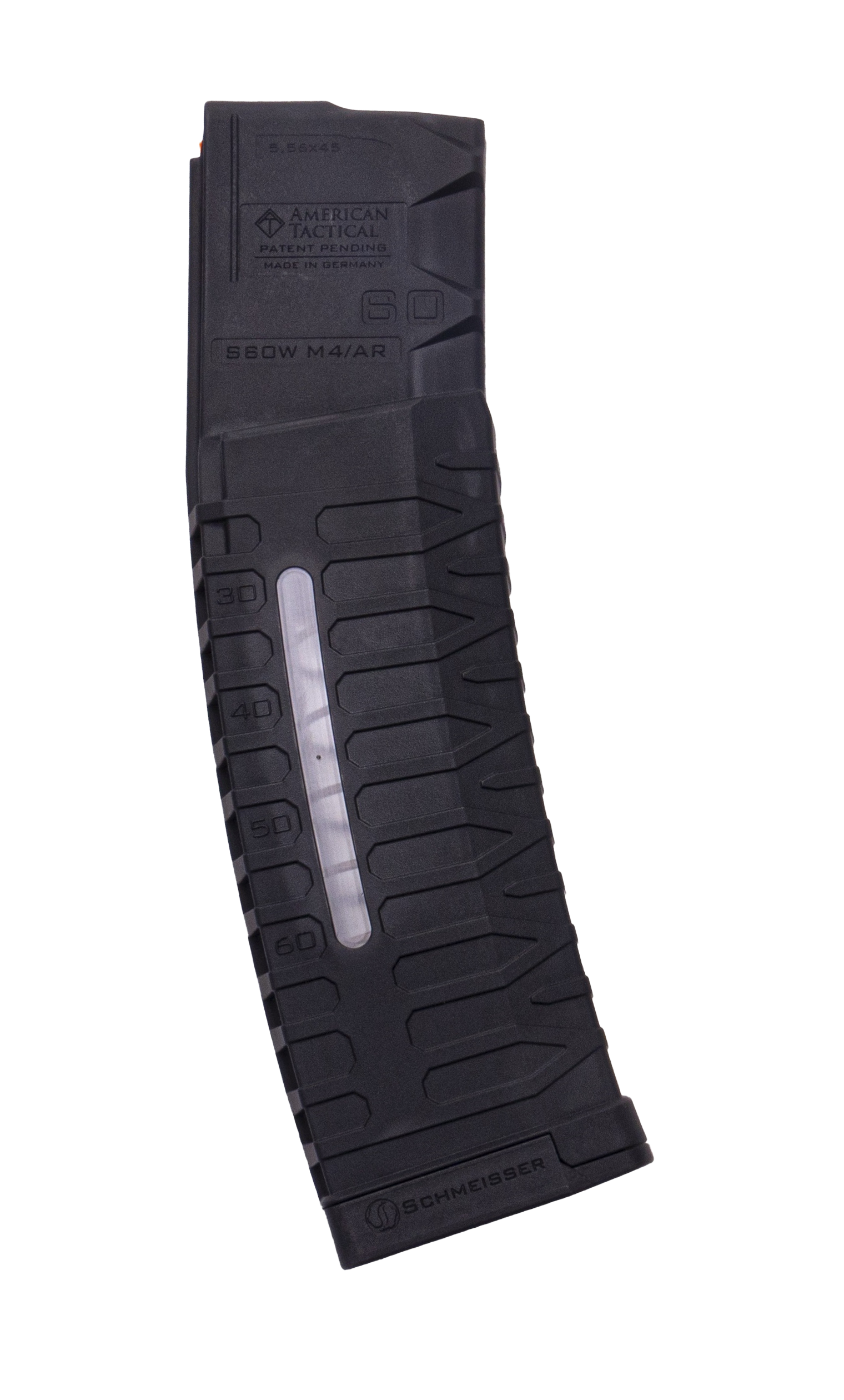
Many shooters run the 2-2-2 drill or something like it. We line up three targets and put two rounds in each, over and back. We vary the range, but it’s usually five to 15 yards. In this case, it was 10 yards. I use either or both optics, depending on what I want to accomplish. We fire a total of 12 rounds loaded in two mags, meaning there’s a mag change during the drill. We load one another’s mags so that we don’t know when the mag change is coming. It might be after the first shot, or the eleventh. Or anywhere in between.
For this friendly contest, we added a fourth target at 50 yards. We varied the basic drill by only firing six shots at the three close range targets and two at the longer target. Transitioning to the 50-yard target required a lateral movement of about five yards. So, we began with two shots for each target at 10 yards, then moved sideways five yards to engage the 50-yard target with two more shots. All shots were unsupported. Got all that?
I used the 1x Vortex Venom at 10 yards and went to the Strike Eagle LPVO, set between 3x and 4x, at 50 yards. Will used the same Primary Arms 3x for the entire drill. We kept our mag change routine, just with eight rounds instead of 12. We ran the drill four times and we did not incorporate a time factor, though we do sometimes. Either way, we fired as soon as we came on target without lollygagging for a “perfect” shot.

We used 2:1 ratio silhouette targets, meaning that, as far as target size goes, we were effectively shooting at double the range. This does not, however, account for bullet trajectory. So, we just see it as choosing to use smaller-than-man-sized targets for a greater challenge. We use our normal holds for the distances we shoot. It’s like shooting at Munchkins or Oompa Loompas.
The Results
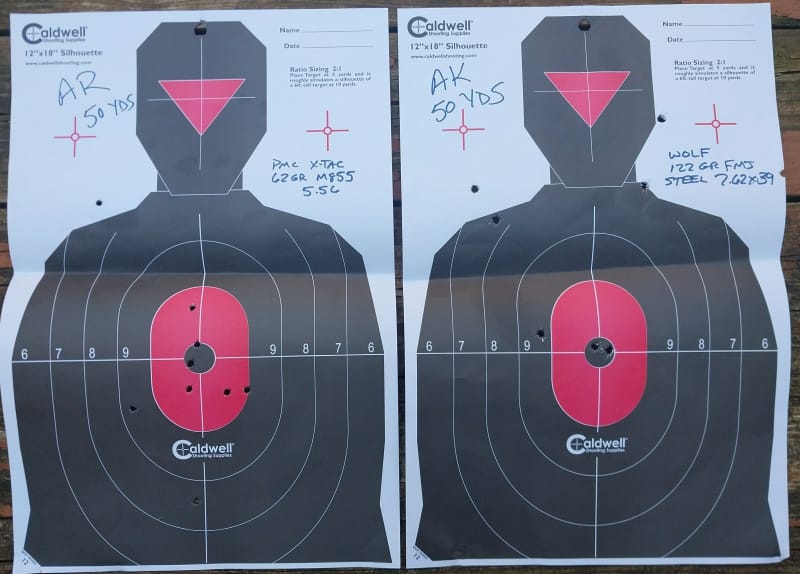
Without all the boring details, we both shot fairly well. All our close-range shots landed in the red. There was no discernable difference between the AR-15 and the AK-103 at that distance. I didn’t know I would be assigned this article, so we didn’t keep those targets. You’ll have to take my word for it. We did, however, keep the 50-yard targets, and that’s where the two rifles separated a bit. I’ve included photos.
AR-15 at 50 Yards
As it turned out, I fired nine total shots at 50 yards because Will miscounted when loading a mag. I noticed the bolt didn’t lock back, and seeing I had an extra round, popped it off. I have no way to know which hole represents that round, so I’m counting them all.
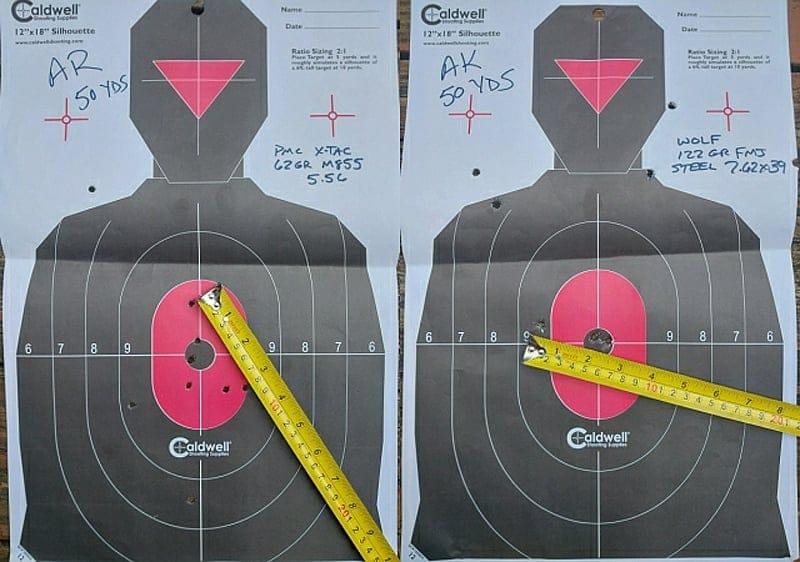
Six of my nine rounds scored in the red, with two bullseyes. That was about a 3-inch group. Another scored in the 9-ring and one more in the 8-ring. The other shot was in the white. It would have scored on a 1:1 silhouette, but I count it as a miss. Not bad, though the miss bugs me.
AK-103 at 50 Yards
Will scored two bullseyes, but those were his only two shots in the red. He landed one more in the 9-ring. That group was about 2½ inches across. One shot was in the 7-ring, though that one was almost in the white at the shoulder. Another nicked the shoulder/neck notch. The other three rounds were in the white. Two of the three would have scored on a 1:1 silhouette. But, again, we count them as misses. The other barely nicked the paper’s edge.
What can we conclude?
This small, unscientific test seems to indicate that the AR-15 is more accurate than the AK-103. This is but one friendly competition using two guns, a small sample size, despite the quality of both firearms. But that has been my experience over many years of shooting both platforms. Other sources indicate the same.
Does that mean the AK is inaccurate? No. It just means the AR-15 is generally the more accurate of the two. The ammo used undoubtedly affected accuracy as well. Better quality brass-cased cartridges would almost certainly have improved Will’s performance with the AK. But like I said, I have reasons for buying the cheap stuff. Knowing my skill level and Will’s, I think the results would have been about the same had we switched rifles.
Reliability was not an issue here. To be honest, I’ve never had reliability problems with either of these rifles. There have been issues with shooter error (meaning me), or malfunctioning magazines, but not the rifles themselves. There was a time when I bought cheap mags for Roza right after buying her. I soon learned better. By the time I bought Eowyn, I was better educated.
I have had problems with cheaper AR-15s, but you almost always get what you pay for with cheap firearms. Thanks to poor training, however, the platform did gain an unfair reputation for unreliability when the first M-16s arrived in Vietnam. The Army literally told soldiers that the M-16 never needed to be cleaned. Seriously. In Vietnam, the patron country of rain, mud, and mold. That didn’t go so well. But a quality AR-15, with average maintenance, will be as reliable as you need it to be.
Roza just runs, but I clean her occasionally because I love her. There have, however, been some less-than-stellar American-made AKs over the last 10 or 15 years. Their issues are well-documented, though US-built AKs are getting much better. You can check out my Mag Life AK 101 series for first-time buyers for more info.
But AKs are generally more reliable than ARs. You can thank their looser manufacturing tolerances for that. There’s simply more room to operate amid any fouling that might occur. Both guns can and do run in the mud, snow, and ice, but AKs will usually run better and longer.
AR vs AK: Apples and Oranges
After owning and running both platforms for years, I don’t compare them. Each does what it’s designed to do. If someone posed the question as to which I like better or which I think is better, my answer is “It depends.” I’m perfectly comfortable drilling with both, and I do. When the Zombie Apocalypse comes, I’ll be happy with either rifle, so long as I have plenty of ammo.
I just see no need to compare, nor do I see a reason to choose—I like having both. I will say, however, that I own several ARs, each setup differently, but I have only one AK. If there’s one clear advantage, I’d say it’s the AR’s versatility. But you could counter that by saying the AK may not be excellent at anything, but it does almost everything well.
The comparisons never end, but I don’t feel the need. That’s why I have both. It’s like having a hot girl (or guy if that suits you better) on each arm. I don’t want to choose, nor do I need to. As someone with a platform, my advice is do your homework. If possible, go to a range that rents both. The two guns are different. They feel different, whether it be ergonomics or the way they shoot. Do that, then buy a quality example of the one you think works for you. You really can’t go wrong either way.