
Initially, I was going to write an article about the long-range accuracy of Ruger’s MK IV 22/45 .22 Long Rifle pistol. A friend of mine mentioned his Glock 44, which is also a .22 LR pistol. Then it hit me: Why not take both to the range and see which is more accurate? We’d pit both pistols against each other in a showdown!
And why not? They’re two very popular .22 handguns, both made by trusted manufacturers. We decided to accuracy test them at 25, 50, and 75 yards to see how they fared. Now we realize that these are very long distances for pistols and are not entirely realistic. Still, the questions nagged at us: how well would they do? Could they even score hits at such distances?
Let’s find out.
The Candidates
Before we dive into the accuracy results, let’s have a look at the particulars of both candidates to see what the technical specifications are and other notable details of both pistols.
Glock 44
First introduced in 2019, this was the very first .22LR pistol in Glock’s lineup. The model used for this test has an extended, threaded barrel designed for use with a suppressor. The barrel length is approximately 4.5 inches, and the threading is .75 RH with a 1/2 x 28 adapter. Barrels on the standard (non-threaded) pistols are 4.02 inches, just like on the Glock 19.
The Glock 44 is basically a .22 caliber version of the Glock 19. It even field strips just like a Glock 19, and most internal parts are nearly identical—except for the thinner barrel, of course.
When you hold the Glock 44, the only thing that immediately tells you it’s not a Glock 19 is that it weighs only 12.63 ounces. Aside from that, it’s hard to tell until you look a little more closely.
Dimensions and Features
The Glock 44’s slide is mostly polymer, with metal parts being molded into it. Serrations are on both the front and rear of the slide. The overall length is 7.28 inches, and the height is 5.04 inches with a magazine inserted. The frame is 1.26 inches at its thickest point, and the slide is one inch thick.
The pistol is fed from 10-round magazines that have open sides and pull-down tabs on either side to make loading the mags easier. The magazines are mostly polymer and very robust, in keeping with Glock’s tradition of making bomb-proof magazines. The grip is modular, with several interchangeable back straps. It also has Glock’s Rough Texture Finish (RTF), which provides a good purchase.
Plus, the recoil is as soft as anyone would expect, and rapid, accurate fire is very easy with this pistol.
Ruger MK IV 22/45
If you close your eyes and someone places this pistol into your hands, you’d swear that you were holding a 1911 pistol. The grip is intentionally meant to mimic that of a 1911, and it feels great. Although it feels as if it’s made from metal, the frame of the MK IV 22/45 is actually made of heavy polymer, which gives it an amazingly solid feel.
How solid? Well, it weighs 34.4 ounces, so it’s not a featherweight. Some of that weight is due to the heavy 5.5-inch barrel, which helps the pistol balance nicely. The overall length of the pistol is 9.75 inches.

Along with the checkered grips and grip angle matching a 1911, the safety also operates just like that of a 1911. It also has a similar slide release and magazine release. Because of the excellent weight and balance, there is very little recoil when firing this pistol.
The MK IV 22/45 magazines hold ten rounds and are mostly made of metal.
At The Range
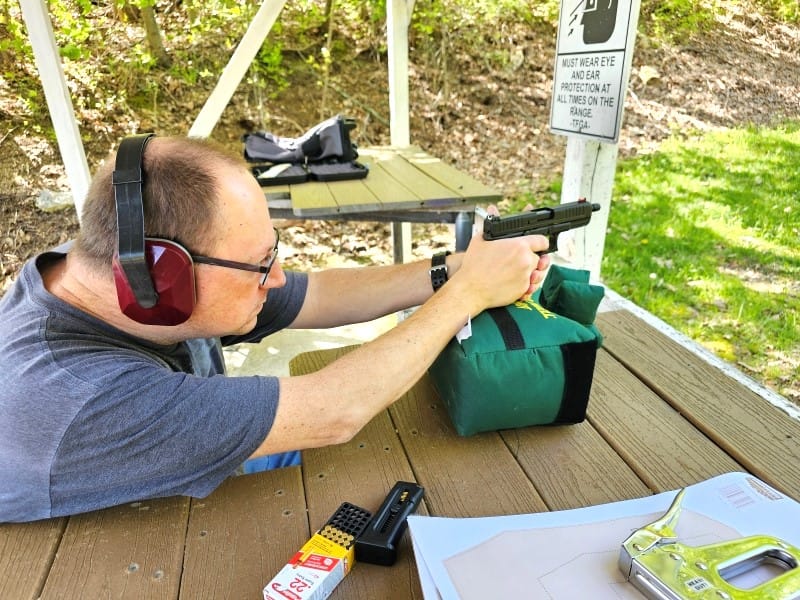
We set targets up at 25, 50, and 75 yards to see what sort of accuracy we could squeeze out of these pistols. I decided to shoot 5-round groups, shooting from the bench and resting each pistol on a Caldwell Deadshot Filled Shooting Bag for stability. This is not typically how I shoot pistols, but I really wanted to try to get the very best accuracy for the test.
Since we did not have match ammo on hand, we used 40-grain, copper-plated Aguilla, which has proven to be reasonably accurate in past experience.
In a nutshell, both pistols kept rounds on target out to 75 yards. We were slightly surprised that the Glock 44 could do this, as we didn’t expect it to.
The Glock did shoot low for both of us, but it made the hits. At closer (more realistic) ranges, the Glock makes good hits and tight groups on targets, and it’s only at the more extended ranges that this particular pistol hits low. Once the shooter knows where it’s hitting, they can correct for the impact. The Glock 44’s sights are non-adjustable aside from drifting for windage (which was not necessary).
The Ruger MK IV was initially hitting very high and to the left at 25 yards. Since it has adjustable sights, a few minutes with a screwdriver and some quick sight adjustments found it sighted in. We were thankful for the adjustable sights.
Results Breakdown
The Ruger MK IV 22/45 is the more accurate pistol, which comes as no shock since it’s intended to be more of a target pistol. The sights, heavy barrel, substantial weight, and the fact that the barrel is fixed give it attributes for very good accuracy.
With that said, the Glock 44 surprised us by doing as well as it did. Bear in mind that we didn’t do several practice runs to warm up for this experiment with either pistol. As best we were able (aside from sighting in the MK IV), we did one cold run with each pistol and printed the results. So, while some of the Glock’s hits went off target, the fact that it was hitting anything at these ranges was seen as a good thing. Had we performed a few test runs, we’d have raised the impact of the rounds and shot prettier groups.
Further, the Glock 44 is not intended as a target pistol. It has a standard action, which means the barrel and other components move, unlike the Ruger. Its sight radius is shorter, and so is the barrel. Basically, it’s intended to be a Glock 19 trainer pistol and not for long-range accuracy. So, the fact that it can print groups on target at 75 yards is rather impressive, especially given that it’s a .22 Long Rifle pistol.
Final Thoughts
The Glock 44 will fit into holsters made for the Glock 19, making it very easy to carry on one’s person should a shooter decide to do so. Perhaps the shooter wants to use it for self-defense or other work. Before anyone laughs at the idea of a .22LR for self-defense, some people choose it for a variety of reasons, one of which might be that they suffer from arthritis or other debilitating issues with their hands. The .22 is simply easier to work with under such conditions.
Ruger’s MK IV isn’t as easily or readily carried on the person. Concealment holsters for the platform are not plentiful. It’s also longer and heavier than the Glock. Overall, it’s not as handy for personal carry.
Each pistol brings attributes that shooters desire. It’s nice knowing they can both score hits out past the range that many would consider realistic.
As usual, it’s all about trade-offs. Readers will have to decide which pistol fits their needs better to make a decision. Honestly, I really like both pistols. I don’t currently own a Glock 44, but I wouldn’t mind changing that in the future.