

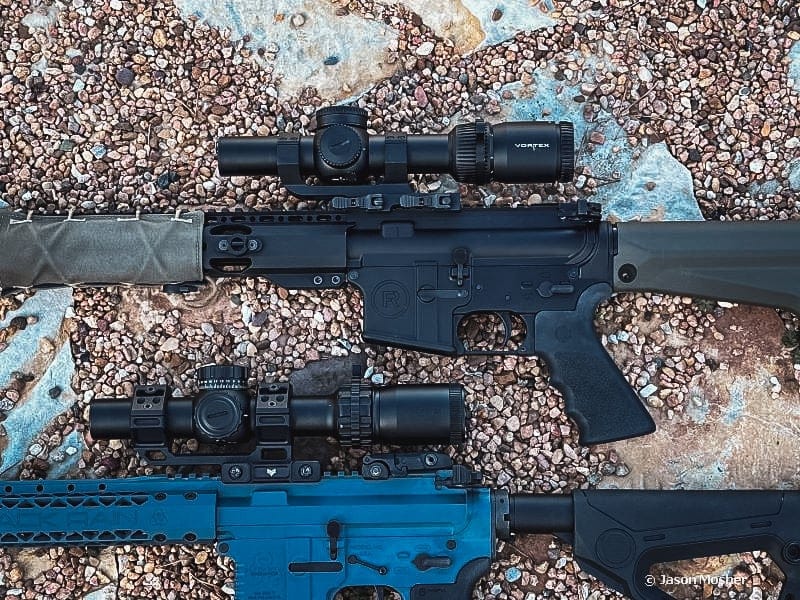
If you are an LPVO guy or gal, we have two great optics to compare today. First is the new Vortex Venom 1-6×24 SFP. Second is the new Swampfox Tomahawk II, also a 1-6×24 SFP. Both optics have battery-powered illumination to help with faster target acquisition. With two optics that are similar in specs and price, it only makes sense to do a comparison article on them.
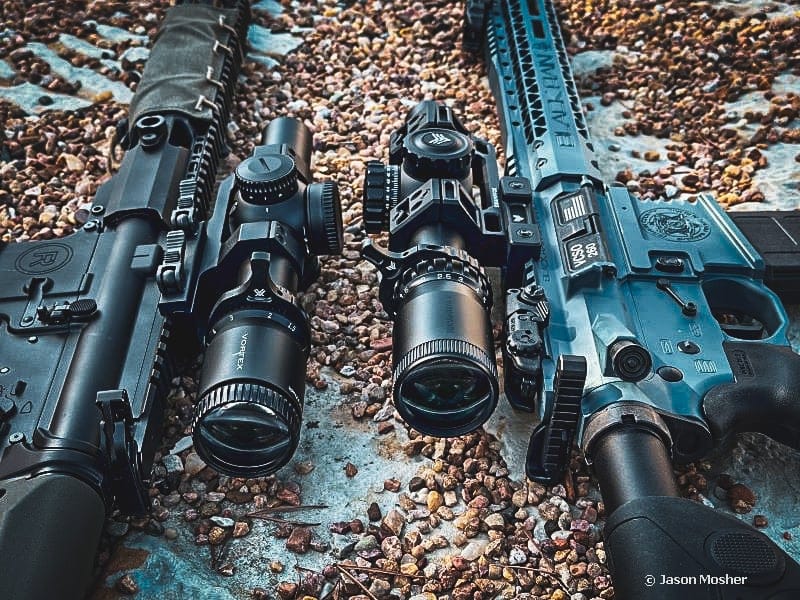
This type of optic is great for multi-purpose use because they work with both up-close and long-distance shooting. I have always preferred a red dot for CQB scenarios and a rifle scope for long-distance shooting. But an LPVO turns your rifle into a gun suited for both applications (within reason). If you’re on the hunt for a new LPVO, here are two great choices that recently hit the market.
What do “1-6×24” and “SFP” mean?
If you are not familiar with magnified optics, you may be wondering what “1-6×24” and “SFP” mean. Here is a quick explanation: the first two numbers are the range of magnification. So, a 1-6 magnification means the optic has no magnification on the first setting and 6x on the last. When you see a number after the “x,” it describes the diameter of the objective lens. The greater the objective lens, the more light is allowed to enter.
“SFP” is the abbreviation for “second focal plane,” which refers to where the reticle sits behind the zoom mechanism. This mechanism is called an erector system, which is the part that creates magnification. When the reticle sits behind the zoom mechanism, it stays the same size regardless of the magnification. When it sits in front, which is called the first focal plane, the reticle will grow or shrink with magnification.
Vortex Venom 1-6X24 SFP
If you’re torn between a red dot or scope on a carbine, an LPVO is a great alternative to both. The Vortex Venom has a 30mm tube and a 3.7-inch eye relief. Its overall length is 10.3 inches, and it weighs 19.5 ounces. When zeroing the Venom, windage, and elevation nobs adjust at 1/4 MOA. This allows you to dial it in close at those longer distances.
For the reticle, Vortex uses the AR-BDC3 (bullet drop compensation). This gives you holdover marks for making those longer shots. Because it’s a second focal plane, the optic will need to be zoomed in all the way (6 in this case) for those hold-over marks to work correctly. When using the last holdover mark, the Venom can stay on target out to 650 yards, a good distance for an LPVO.
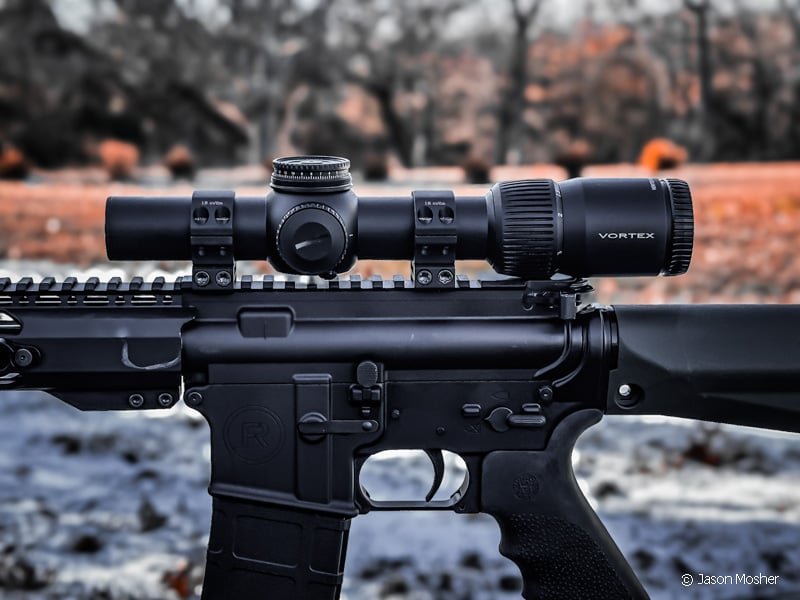
You select from six brightness settings, and an “off” position between each one makes it easy to go directly to a specific setting. Metal covers protect the adjustment knobs from getting bumped once you zero the optic. Nothing locks them in place; just remove the metal cover and make the needed changes. They do have a good solid “click” with each turn of the knob.
Swampfox Tomahawk II
When you look at the Tomahawk II, there doesn’t appear to be much difference between it and the Vortex Venom. It is also a 1-6X24 SFP with a 30mm tube, weighs 1 once more, and is just a hair shorter. However, there are some differences between the Tomahawk II and the Venom. First is the illuminated reticle. While the Venom has a dot with a half circle above it, the Tomahawk II uses a center dot only.
I’m not sure one is better than the other, but some will have a preference. Compared to the Venom’s 6 illumination settings, the Tomahawk has 12 with an off position in between each one as well. After using both optics during the day and in the evening hours, I found both illumination settings to be sufficient. I’m not sure I would ever use 12 brightness settings, but it doesn’t hurt to have them, right?
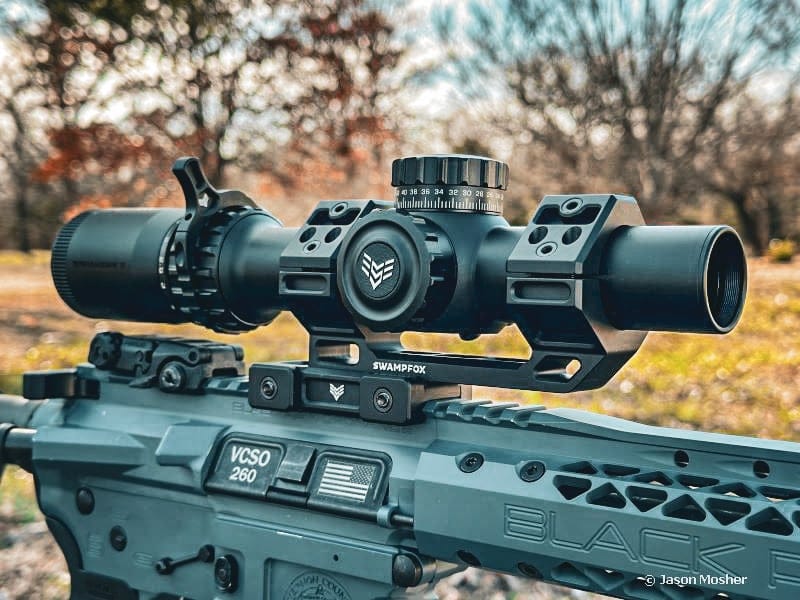
Both optics come with a throw lever for making quick magnification adjustments. However, they are backward from each other. To increase the magnification of the Venom, you turn the lever to the right while the Tomahawk II turns to the left.
Apples to apples?
On the range, both optics were easy to zero and appeared to be built very well. Each one runs on a 2032 battery, and both come with flip-up lens covers, a cleaning cloth, and instructions. Vortex and Swampfox sell 30mm mounts for a Picatinny rail for mounting to an AR-15. I own multiple Vortex optics, and I have never had any issues with them.
Swampfox sent me the Sentinel II last year, and I baked it in the oven, soaked it in water, and froze it. It’s been on my Glock 45 that I carry at work for months and appears to be a great optic. When you find two good products like this, all you can do is look at the differences and make a choice. The Swampfox Tomahawk II retails for $429, and the Vortex Venom for $449.99.
Speaking of standing behind their product, Swampfox also offers a lifetime warranty. They cover any manufacturing defects or flaws in the structural housing and glass, which includes everything but the illumination. For that, they offer a 10-year warranty from the date of manufacture. Neither company requires the product to be registered, and both companies provide their phone numbers, addresses, and emails on their websites.
Two great choices for the same reasonable price
Picking one of these two optics is a hard choice, but I believe either one is a great decision. After using them both, I can’t say I find anything I don’t like about them. Each LPVO has a clear lens, fast focus diopter, and, most importantly, stays zeroed after being banged around some. Look over each one and decide which one is right for you. Once you make your choice, have fun on the range and even on your next hunting trip.