

Pistol compensators are the subject of much debate: what do they really do for a handgun? Is it worth getting one if you aren’t a competitor? Before you make your decision, do your research and let it begin here. Keep reading to find out what a pistol compensator is, how it works, and what it can or cannot do for your gun game.
Pistol Compensator History
You might think compensators are a recent addition to handguns, but you’d be wrong. They have their roots as far back as almost a century ago when mobster John Dillinger wielded a Lebman 1911 with a compensator attached. Those may not have been exact replicas of today’s designs but the concept was the same.
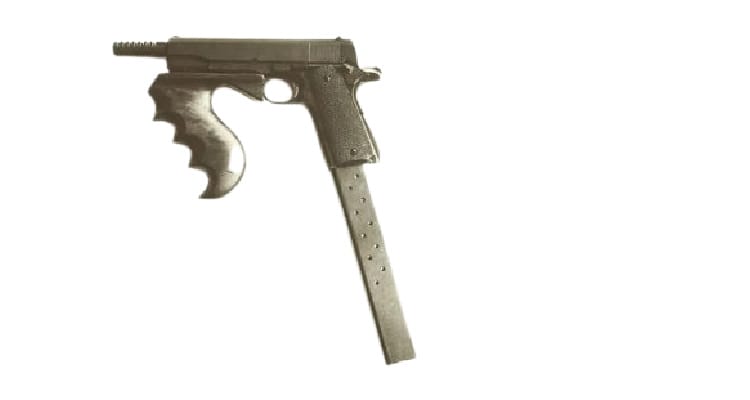
Those compensated pistols of years past were designed by gunsmith Hyman Saul Lebman of Texas — because of course, Texas — who unwittingly made the first few for mobsters who had approached him for some custom gun work. The end result was a 1911 with a broad wooden foregrip, an extended magazine, full-auto capabilities, and a seven-port compensator. There is an entire fascinating story behind the creation of those guns and poor Lebman’s eventual prosecution but that’s a tale for another day. As for the compensators, decades would pass before they began seeing use in, shall we say, polite society. It was the 1970s when compensated pistols began seeing use not only for competition but by those carrying said guns for self-defense purposes. Even so, the device didn’t really start gaining traction in the gun world until the 21st century. Today they remain hit-or-miss in popularity. Gun owners are starting to consider their use outside competitive circles although we wouldn’t call them commonplace just yet.
How Does a Pistol Compensator Work — and Why?
When you fire a gun, the gas created by the process goes the only way it can: straight out of the gun. This means muzzle rise occurs as those gasses escape in a rapid stream. And although the gas moves forward it does create an equal amount of force to the rear (hello, felt recoil). By using a compensator you give the gasses another means of escaping: through various ports in multiple directions, thus offsetting the one-direction force that creates so much muzzle rise and felt recoil.
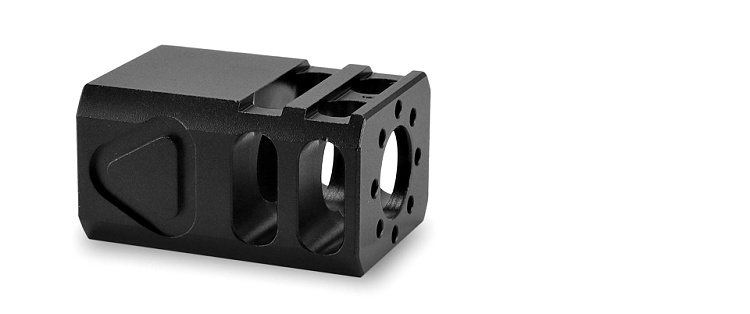
Keep in mind there are different kinds of compensators, this is simply a basic, generalized explanation. Compensators have the additional benefit of adding some weight to the muzzle of the gun which also does its part to flatten out the gun as it is fired. It’s a logical solution to something you may or may not see as an issue in your own personal trigger time. Why would you want to use a pistol compensator? The answer is obvious: to reduce muzzle rise and felt recoil, for improved accuracy and more rapid follow-up shots. As for whether pistol compensators work? Yes, yes they do. Your own application may vary but the basic premise behind their existence is legit. They do exactly what they promise, albeit to varying degrees depending on the design and caliber of the gun.
Concealed Carry and Compensators
There’s a decent amount of debate regarding whether or not concealed carry is compatible with pistol compensators. The short answer is yes, you can conceal a pistol with a compensator on it. There are quite a few options on the market for compensator-friendly holsters and myriad compensator models available to suit various needs. You might be surprised just what you can conceal given the correct holster and gun belt combination. That said, there’s a deeper question you should be asking yourself here: just because you can do something, does it mean you should?

Legally speaking, carrying a compensated handgun for self-defense is a bit of a gray area.
If you were to be involved in a self-defense situation, it could go one of two ways: you could be portrayed by the prosecution as someone who purposefully worked to make their gun more lethal — and therefore were spoiling for a fight. Or, you could be defended as someone being a responsible shooter. On the side of responsibility, your compensated pistol could be explained as a flatter-shooting, easier-controlled gun that was less likely to result in missed shots — which means that your foresight protected innocent bystanders. Carrying a compensated pistol doesn’t necessarily result in losing a case but it is highly likely to result in higher attorney’s fees for your defense. In order to make this decision you’ll have to weigh the pros and cons from a logical, factual standpoint and make your own choice. Simply be aware it may cost you — literally — in the long run. On the pro side of putting a compensator on your carry gun, there is, as mentioned above, the reality of accuracy. When you’re under stress your accuracy is probably going to be reduced. It could be a good thing to get the extra edge offered by the reduction of felt recoil and muzzle rise. Those advantages could protect innocent bystanders and end the threat with greater speed since you may be able to get your shots more precisely on target.
Competition Uses
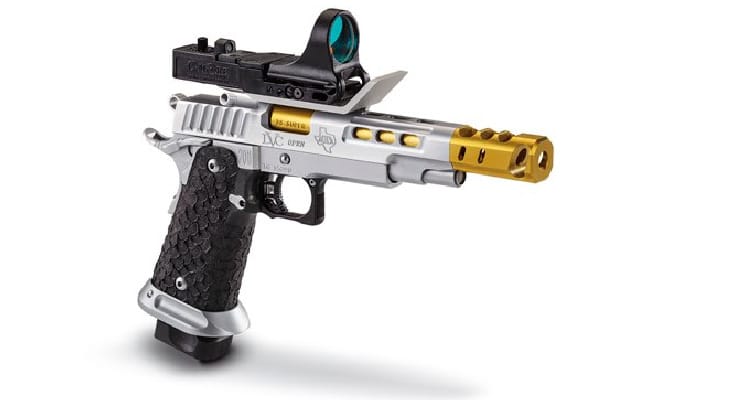
Of course there are clear reasons to use compensated pistols in competition. You need to know what is allowed in your division and adhere to those rules but if you’re allowed to use one it can up your game. Do your research to be sure you understand the different types of compensators and their uses. Flatter shooting, rapid target acquisition, and superior control overall? Yes, please.
Legalities

We already went over the ins and outs of concealed carry guns with compensators but haven’t yet touched on whether the devices are legal in general. Yes, they’re legal. Compensators do not suppress firearms and are not subject to the restrictions of the National Firearms Act of 1934, which restricts things like suppressors and full-auto guns. However, it is vital you become familiar with your area’s laws and keep up with any changes. This goes for any and all places you intend to travel with firearms as well. Claiming ignorance of a law will not protect you in a court of law. Knowing the law as it applies to your firearms and their use is your responsibility.
Blinded…or Deafened…or Not…

Under the right circumstances, using a compensator can result in a significant muzzle flash. A lot of factors come into play when it comes to just how much flash we’re talking about, though. Everything matters — from which ammunition is used to the design of the part to the gun’s barrel length. So, yes, there is likely going to be a bit more noticeable flash when using the device than without it, but it won’t necessarily be enormous or problematic. You can capture muzzle flash from unadorned factory handguns with well-timed photography, too. It isn’t something only compensated pistols produce. If you are worried about flash, run the gun compensated and find out for yourself exactly what it produces. The odds are that it will not be disorienting, but all shooters are different, and various gears produce a variety of end results.
What about the sound?
Compensators produce varied sounds. They’re not made to suppress sound at all, nor are they typically designed to magnify it. (Of course, there are always some on the market that quite literally give you the biggest bang for your aftermarket product buck). Depending on how the device disperses the gas leaving the barrel, it may or may not make more noise than it would without the device. This is device-dependent and is also influenced by the type of ammunition used and barrel length, among other things.
Compensated Pistols and Power Loss
As with the concerns that compensated or ported handguns can harm the shooter in certain situations, there is a bit of truth to the same pistols not having as much power as handguns without porting. The concept is simple. When a round is fired, expanding gases force the bullet from its case and then down and out of the barrel. Once the bullet leaves the muzzle, those gases do nothing but vent off into the atmosphere. But with ported guns, that venting starts before the bullet even leaves the barrel. Some of those propellant gases begin to vent, and there is now less gas available to force the bullet out of the barrel than would be available from a solid barrel. Logic would follow that with less gas available at the muzzle, the ported handgun’s bullet will have a lower speed and less power. But does porting adversely affect velocity, and if so, is it enough to make a difference as you debate whether you should go the ported route? To answer that, I hauled a few 9mm handguns with identical barrel lengths to the range and shot some ammunition across my chronograph to find out.
Ported vs. Non-Ported Handguns: A Velocity Test
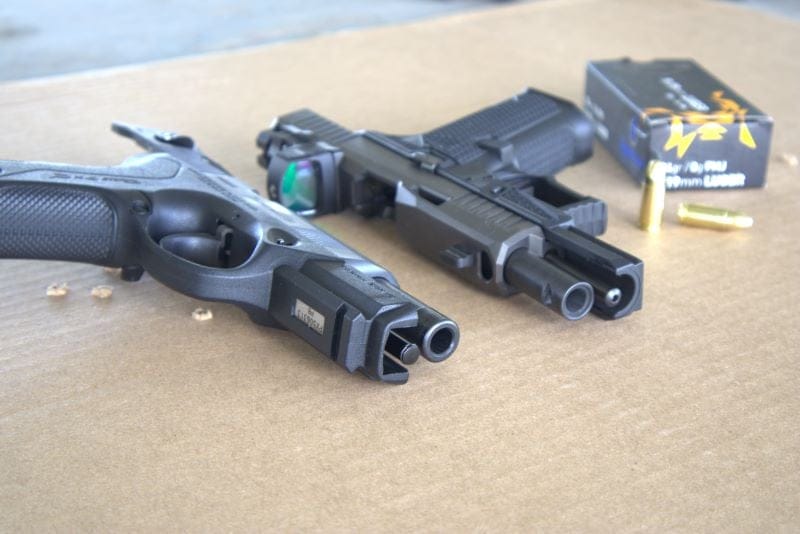
I tested three different handguns chambered in 9mm Luger. The first was my Rainier Arms Dusk 19R. It is an excellent Glock 19-like handgun, and my example comes with a single triangular port in the barrel and slide. The Dusk wears a 4-inch barrel, so I paired it off with two other non-ported handguns with the same barrel lengths. These were a Beretta Px4 Storm G-SD and an Arex Delta Gen. 2. I initially shot the Dusk head-to-head with the PX4 but later included the Arex because the Dusk and Arex use the same Browning locked-breech design. The Px4 Storm’s rotating barrel may otherwise skew the results. I set up my Caldwell Chronograph at a distance of ten feet from my bench rest and fired five-shot groups from each pistol using four different types of ammunition across all of them.
| Dusk 19 (ported) | Arex Delta | Px4 | |
| Igman 124 grain FMJ | 1052 | 1088 | 1099 |
| Winchester 115 grain JHP | 1055 | 1112 | 1076 |
| Federal Punch 124 grain HP | 1073 | 1099 | 1087 |
| Barnes Tac XPD 115 grain +P | 1016 | 1104 | 1070 |
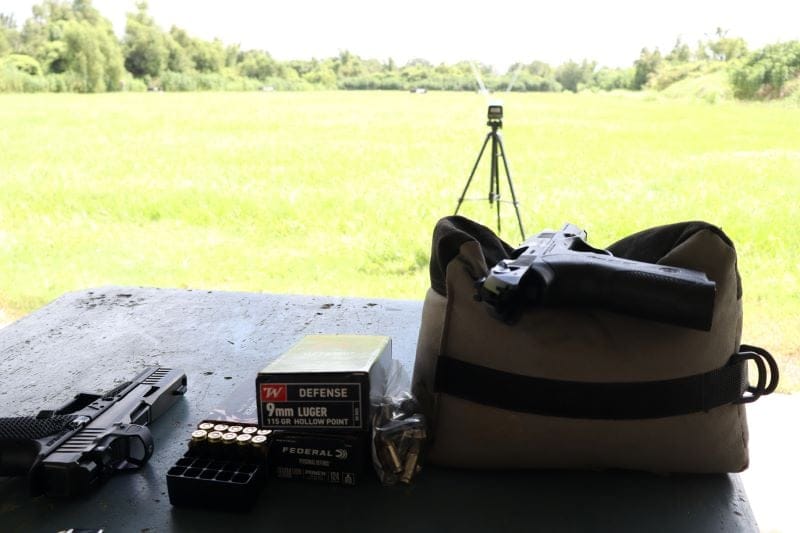
Different ammunitions perform differently in different handguns as they vary from lot to lot, as do the handguns themselves. For example, the Igman 124 grain FMJ target loads I started out with yielded the highest velocity out of the Px4 Storm, but that pistol consistently performed behind the Arex. The ported Dusk 19R with a 4-inch barrel consistently delivered lower velocities compared to the Delta and Px4, both of which lack porting or compensation of any kind. But the differences aren’t as stark as one would expect. With the same ammunition, the ported Dusk had a velocity loss of only 36 feet per second. That is close enough to represent one shot to the next and immaterial to real shooting. The Arex, with its solid, tilting locked barrel, pulled further ahead using Winchester 115 grain and Barnes TAC XPD ammunition, but the differences using Federal Punch were quite close, with the Dusk behind by only 26 feet per second.
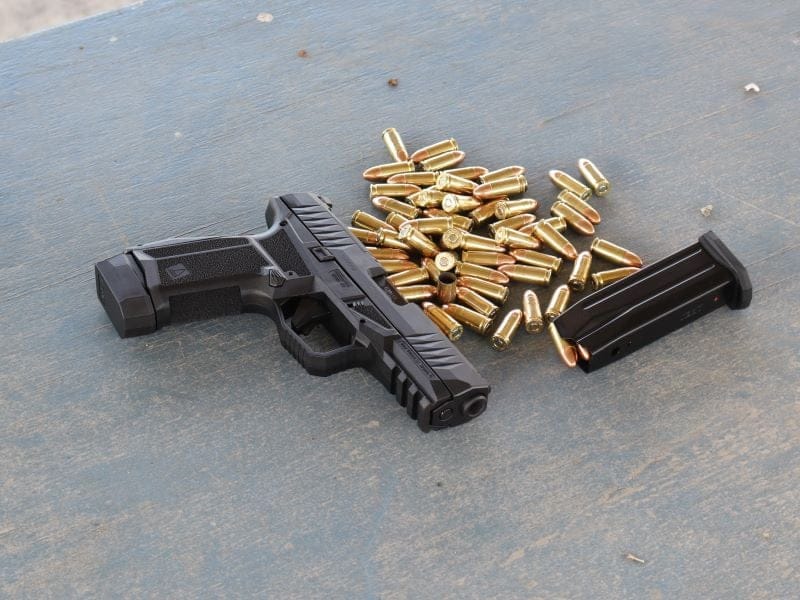
The biggest difference came with the +P Barnes XPD all-copper round. The Dusk clocked in an average velocity of 1,016 feet per second, while the Arex was over 90 feet per second faster. That is not the margin from one shot to another, and at these lower velocities, that is enough of a difference to impact bullet performance to a degree. Like other +P loads, the Barnes is hotter than standard pressure loads, and I could visibly see more coming from the muzzle of the Dusk 19, where the flash was less pronounced than that of the other pistols. The powder hit the air and burned rather than staying in the barrel a touch longer to burn.
Bottom Line
The only person who can answer whether or not a pistol compensator is a good idea for you is…you. If you’re a competitive shooter, it will depend on your division. If you carry for self-defense, it depends on personal preference combined with weighing the pros and cons on your own. They are not regulated items, and there are a lot of benefits to their use.
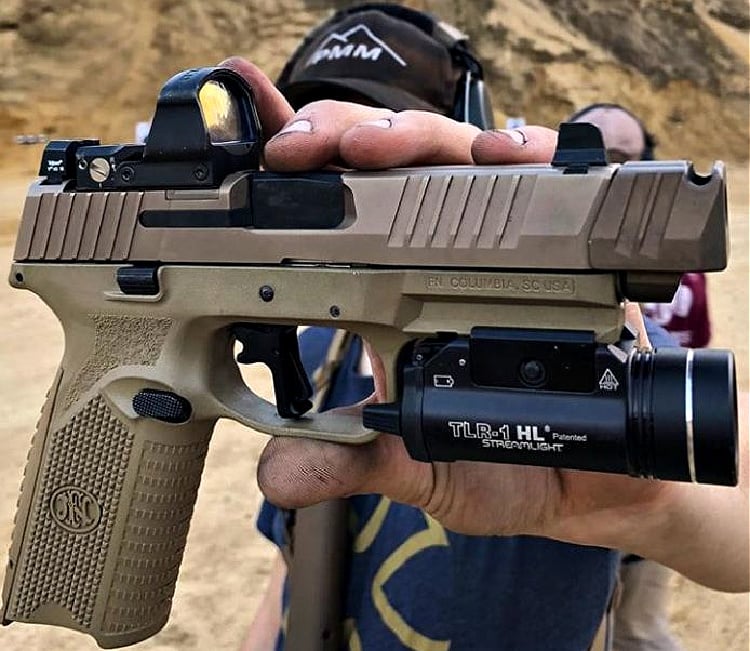
Educate yourself. Do your own research and be prepared to try more than one brand before settling on the model and design that best suits your specific needs. All shooters are different, and what works for the guy next to you on the firing line may not work for you. Put the time and research into it, whether it’s for competition or your carry gun. Being an informed gun owner is always the way to go.
