
In 2002, Vortex started out making binoculars. Later, they moved into rifle scopes, spotting scopes, rangefinders, tripods, and a pile of other quality products. When hunters heard about Vortex’s binoculars, they became an instant hit. Eventually, when Vortex began producing rifle scopes and other shooting gear, shooters didn’t take long to begin buying them up.
The Scopes
In this article, I’ll review two Vortex scopes. The first is the Crossfire II 2-7x variable-power scope, followed by the Strike Eagle 1-8 power LPVO (Low Power Variable Optic) scope. Let’s get to it.
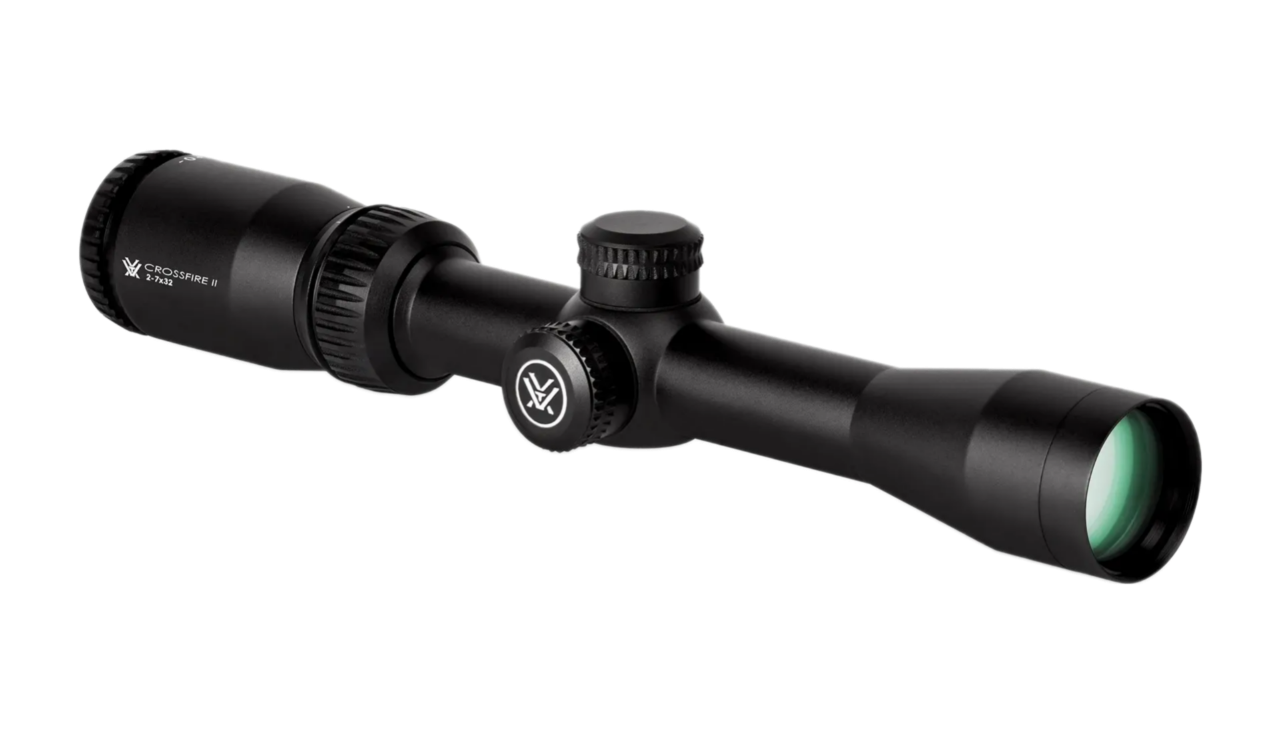
Vortex Crossfire II 2-7x
We’ll start the reviews with the Crossfire II, which has a magnification range that starts around 2x and goes up to 7x (power is how many times the scope can magnify the view). At 7x, it will seem like the viewer is seven times closer to the target.
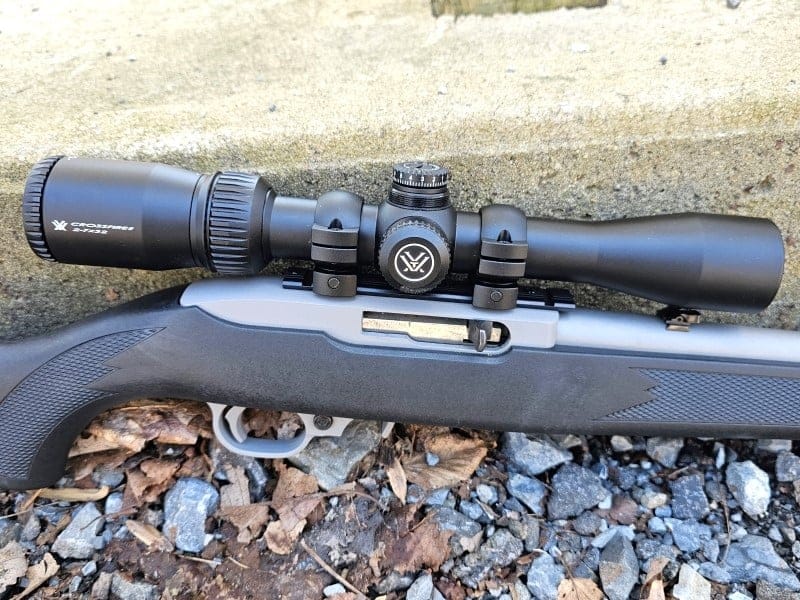
- Weight: 13.9 ounces.
- Magnification: 2-7x
- Overall length: 11.52 inches.
- Height: 1.61 inches.
- Objective Lens: 32mm.
- Tube Size: 1 Inch.
- Adjustment Graduations: 1/4 MOA.
- Maximum Elevation Adjustments: 60 MOA.
- Maximum Windage Adjustments: 60 MOA.
- Field of View at 100 Yards: 12.6 to 42 feet.
- Eye Relief: 3.9 inches.
Other details
The scope is constructed of aircraft-grade aluminum, which makes it durable. Armor Tek protects the lenses from scratches and other damage. The scope is also rated as shockproof. One thing we liked about this scope is the very simple, straightforward reticle, which is of the duplex persuasion. It’s not cluttered and busy like some reticles we’ve run across. There are heavy stadia lines nearer to the edges of the objective lens, and they narrow toward the center of the reticle to provide more precision.

The glass is clear and crisp from the shooter’s perspective, allowing good observation and precision with this scope.
Rifle/Scope Combo
We mounted the Crossfire II 2-7x scope on a Ruger 10/22 in .22 Long Rifle. This scope was mounted on a friend’s rifle as he was looking for an optic that would give him more precision than open sights. He also wanted to extend the effective range of the rifle. We can report, with all certainty, that the Vortex succeeded on both counts. Groups tightened up considerably, and we were able to get better hits at longer range with the 10/22 using this optic. At 50 yards, we printed a few groups that were well under an inch.
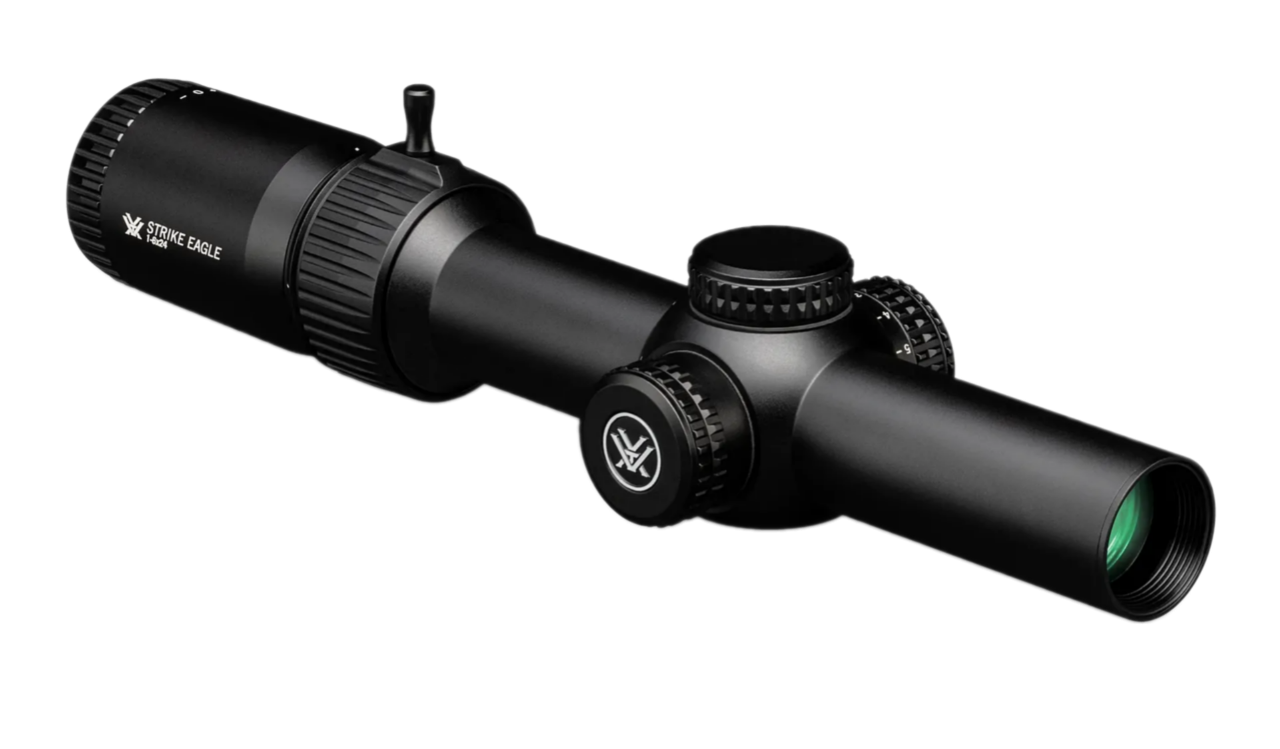
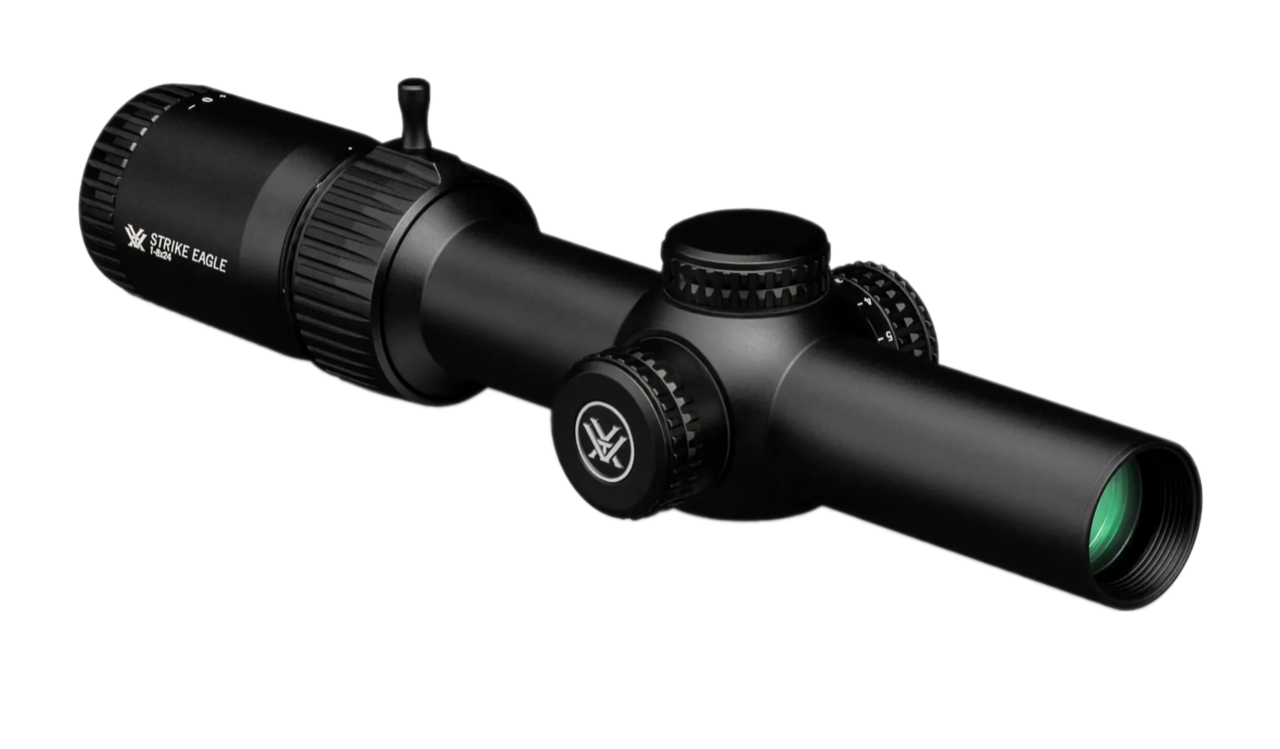
Vortex Strike Eagle 1-8x
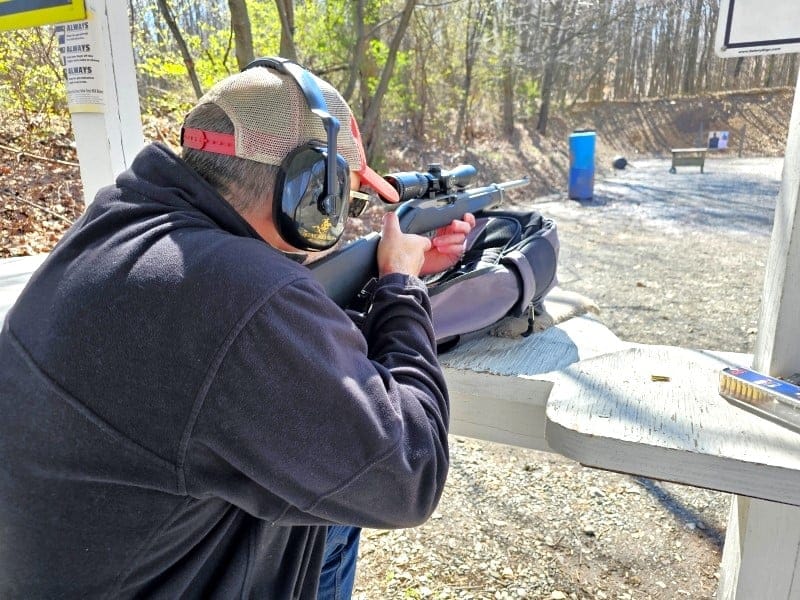
Next up is the Vortex Strike Eagle 1-8x scope. I teamed the scope up with a Savage MK II FV-SR rifle in .22LR, as I wanted a lightweight, compact scope for the rifle because it’s a compact rifle. Like the 10/22 above, this is a compact rifle and a huge scope on it would be ridiculous. The scope works well on the little .22 but might be more suited to an AR-15 or other, larger semi-auto rifle.
To that end, the Strike Eagle works very well. The range of magnification also works well for the rifle, as it’s not a very long-range rig, and I didn’t need a ton of magnification. At 50 yards, I was able to shoot groups well under one inch with this rifle and scope. The glass gives a sharp, clear image that makes obtaining good hits easy.

- Magnification: 1-8x
- Objective Lens: 24mm.
- Tube Size: 30mm.
- Maximum Windage: 140 MOA.
- Maximum Elevation: 140 MOA.
- Field of View at 100 yards: 14.4 to 109 feet.
- Eye Relief: 3.5 inches.
- Length: 10 inches.
- Weight: 17.6 ounces.
Other Details
Scope settings can be recorded due to the numbered tactical/target turrets, which are protected by screw-on protective caps.
The reticle resembles an upside-down horseshoe that can also be illuminated for low-light conditions. The reticle can still be seen if the battery dies, as it is etched into the scope’s glass. There are also stadia lines on the scope, which assist in range estimation and holdover for various ranges. The holdovers are calibrated for 5.56mm rounds, so they’re not much use with the .22LR. The range estimation and holdovers go out to 600 yards.
Adjustments for the Strike Eagle are in 1/4-MOA increments.

Warranty
In my personal experience, Vortex has one of the best warranties I’ve ever seen. On one occasion, I had an issue with one of their scopes. Upon contacting the company, they were extremely apologetic, asking me what issue I was having, which I described to them. Their response was simple: they sent me a brand new scope with instructions to put the old scope into the box and return it to their factory with the prepaid return postage. In a couple of days, I had the new scope and sent the old one back to them. It was that simple! Now, that is what I call customer service!
Since then, I’ve used a half-dozen of their scopes, and all have worked well. Vortex cares about its customers, and they’ve made me a customer for life.
Final Thoughts
Is one of these scopes vastly superior to the other? To be perfectly honest, we could have switched these scopes up and put them on either rifle with similar positive results.
The Strike Eagle, with its 1x lower-end magnification, is better suited to the semi-auto rifle it’s intended for. It also checks off the other boxes by allowing the rifle to reach a much greater distance. To be honest, it was intended for the AR-15 platform and other similar rifles/carbines. That said, it works nicely on the Savage that I have it mounted on.
Both scopes offer a clear, sharp image, indicating good quality. Both are easily adjustable, with their tactical turrets. Neither one weighs a lot, and both are reasonably compact, with the Strike Eagle being the more compact option. On the flip side, the Crossfire II is more economically priced. Further, both scopes allowed the rifles on which they were mounted to shoot very tight groups, which was the goal all along. To that end, they have succeeded enormously.
Without a doubt, you won’t go wrong with either of these scopes, as both offer a respectable range of magnification that doesn’t go overboard.