

There’s lots and lots of talk about optics these days. We have red dots, prisms, LPVOs, traditional variables…you get the idea. And let’s don’t forget they are cheaper than they’ve ever been too. It’s increasingly rare to see an iron-sight-only gun. However, with lots of new shooters wielding optics, we’ve seen a theme appear. It seems that more and more people are bridging optics without knowing why it’s a bad idea.
What’s Bridging Optics?
Heck, people who are bridging optics might not even know what the term means or what they’re doing. Bridging optics is the act of attaching an optic to a portion of the handguard and a portion of the optic’s rail. You know what, just for fun, we’ll talk about not only bridging optics but also mounting them directly to the handguard.
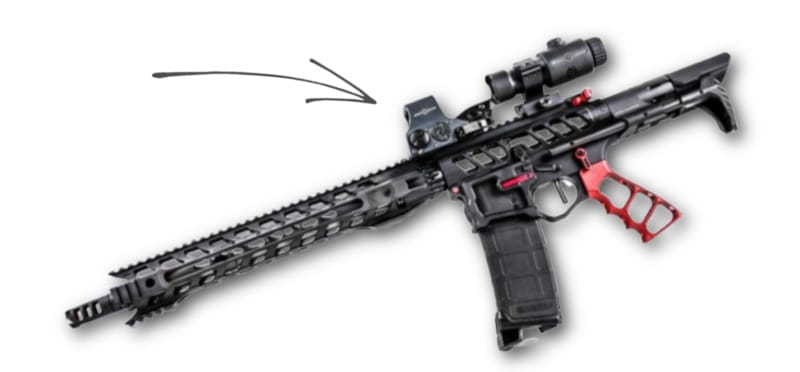
People bridge optics for a lot of reasons. Some just don’t know any better and toss the optic where it fits. Some optics are longer than the optic’s rail, and shooters just grab a set of rings that fit—one ring on the handguard and one on the optic’s rail.
Others might not think they have enough room to use a red dot, magnifier, and set of BUIS. However, these days there is plenty of room for everything with modern mounts, optics, and magnifiers.
Why Is It Bad?
So why is it bad? Well, optics enhance accuracy. Thus, they are required to be zeroed. Zeroing requires a stable mount, and a handguard doesn’t provide stability. Handguards move and flex from the pressure applied by your hands, barrier rests, slings, and more. That will affect your zero significantly.
Mounting to a portion of the handguard or directly to the handguard is a bad idea. Bridging optics sucks and won’t give you the best possible zero or allow you to maintain that high degree of accuracy we all know and love.
