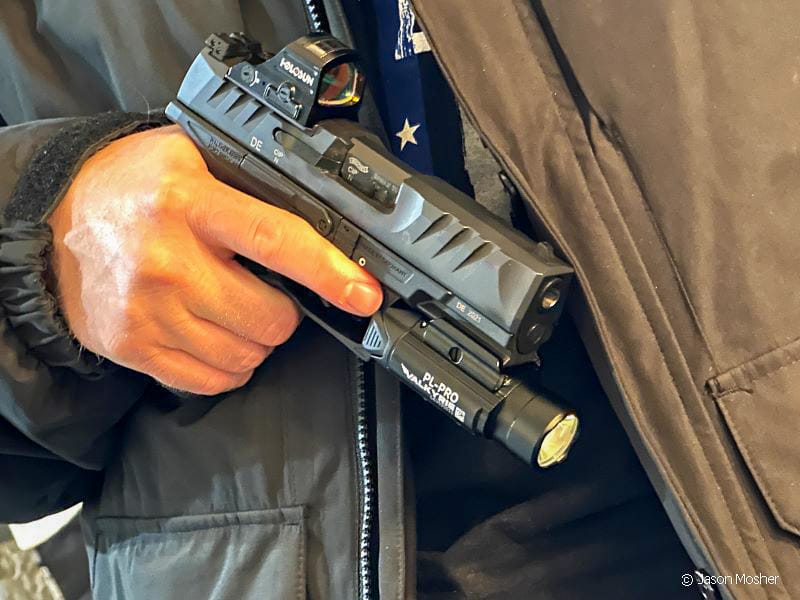

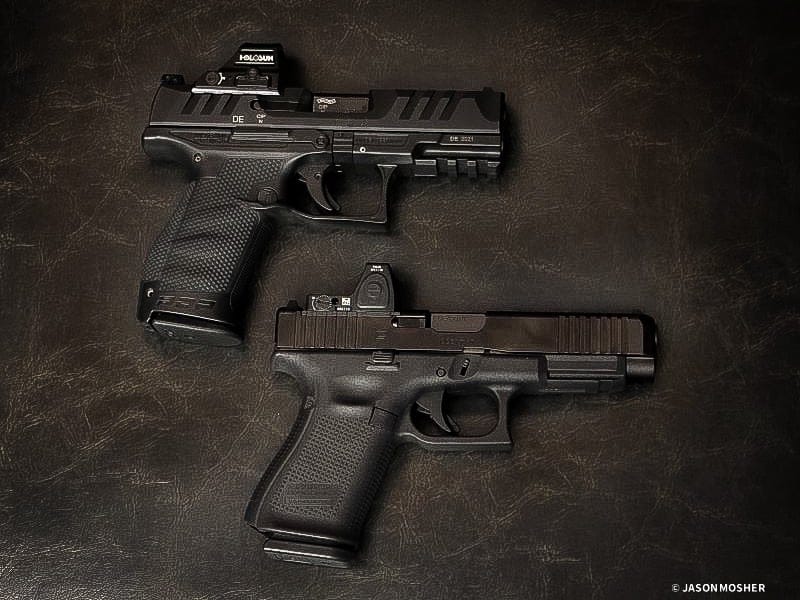
The new Glock 49 has some gun enthusiasts swooning and others annoyed with another crossover handgun. Walther is making so many versions of the PDP that it’s hard to keep track of them. Both gun companies are legendary in their own right, so debating the quality of either gun is a waste of time. They are both reliable handguns using completely different styles, which makes them good comparison guns for those unsure of which one to buy.
Picking between these two handguns is like choosing between an AK-47 or AR-15 rifle. Different flavors for different tastes. But there are some, like me, who love both guns, and this makes it hard to choose. Are there any benefits to one over the other? Each gun does have advantages and disadvantages to consider when selecting the “right” one. I’ve had both out on the range for some drills and good old-fashioned pop-can plinking.
The Long Road to a Compact Glock with a Full-Length Slide
Gaston Glock found a reliable gun that worked and stuck with the design. There are plenty of models out there, but they are different versions of the same gun. Now that he’s gone, there is speculation as to what direction Glock will take. Could there be a revolver, AR-15, or bolt action gun someday? Only time will tell. But for now, their newest gun, the G49, is a crossover between the G17 and G19. Some blew the G49 off as a half-hearted attempt at releasing a “new” gun.
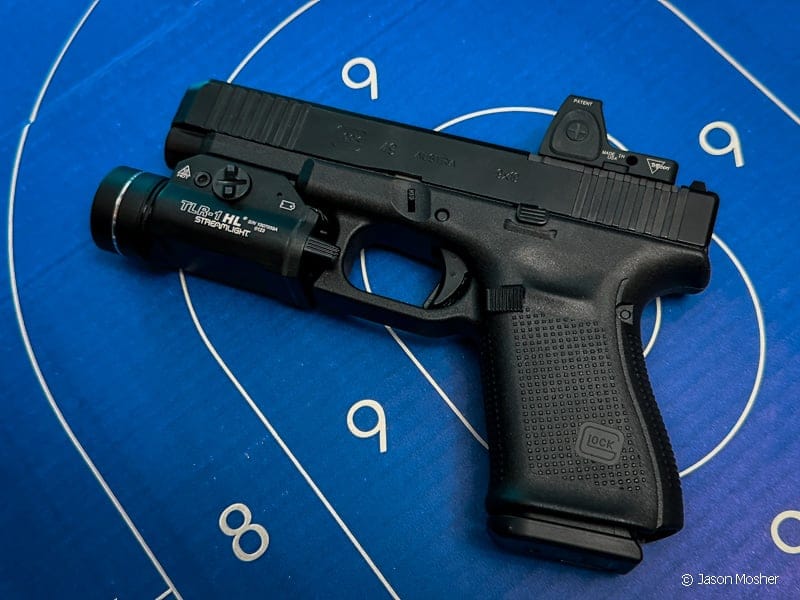
When Glock introduced a new crossover several years ago, I was hoping for something close to the PDP. Instead, we got the Glock 45, which is a crossover of the G17 and G19 but backward: a long grip (G17) with a short slide (G19). We started carrying these at work, but again, I wasn’t the biggest fan.
Glock 49 MOS, the newest crossover in the G-World
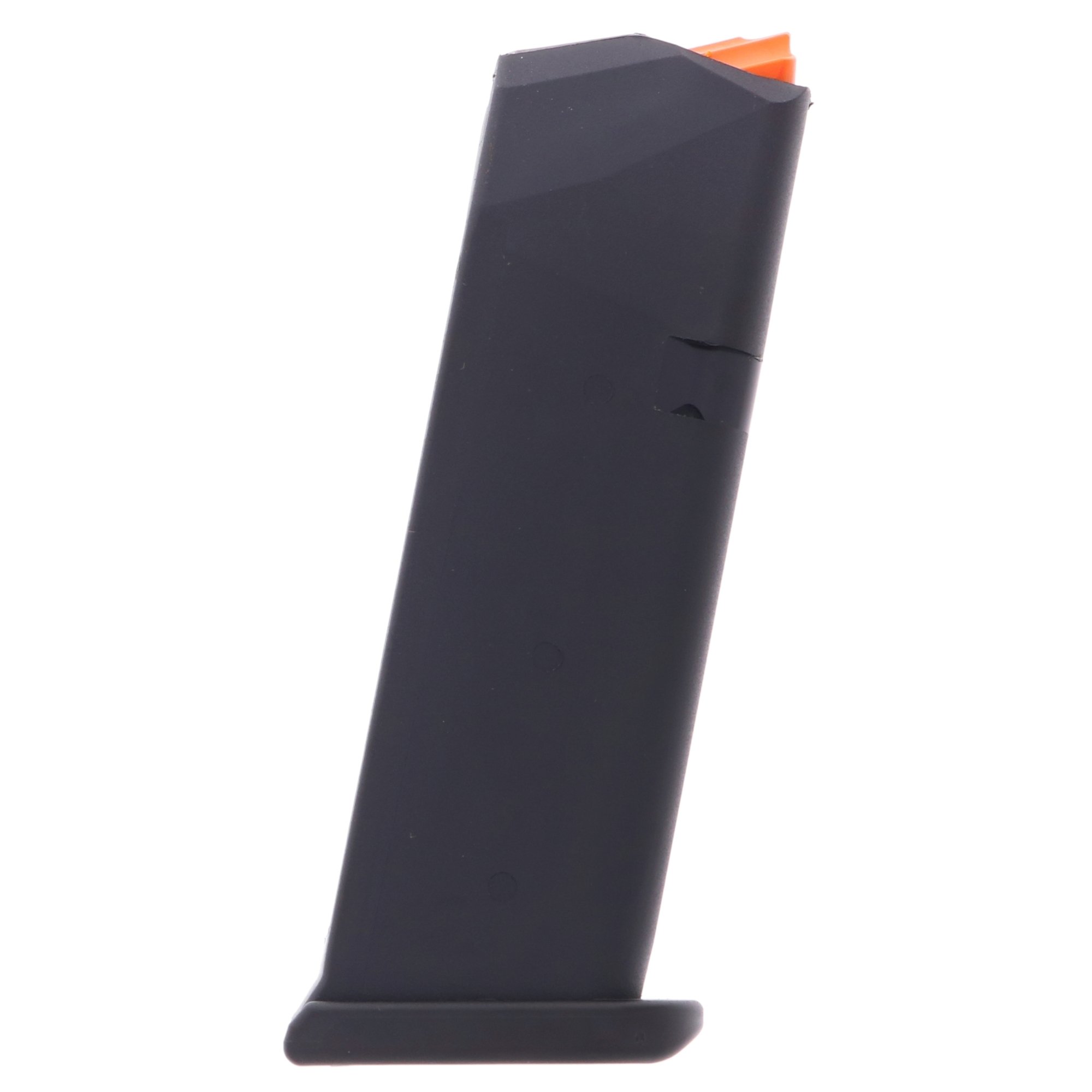
Once Glock released the G49, I scrambled to get ahold of one. A week later, I was at the range with one in my hands, and it became one of my favorite guns. As I mentioned above, it’s a Glock 17 slide (modified just a little) that rests on a G19 frame. The slide is modified to use a G19 recoil spring and guide rod. Basically, everything on this gun except for the barrel and slide itself are G19 parts. I tend to shoot better with the G49 than I do with the full-size G17 or compact 19.
I won’t get into all the specs of either gun, as they can easily be looked up on the company’s website. But instead, I want to look at the strengths of the G49 compared to the Walther PDP. The first one is the MOS system by Glock. If you are going to use a red dot, Glock makes it super easy to attach one. When you buy an MOS-ready gun, it comes with multiple adaptor plates for just about every popular footprint on the market. You don’t have to buy any plates; just select the plate with the correct footprint and attach the optic.
Shop This Article


Walther’s evolution from the infamous P99
In 2003, Walther introduced a special edition of the P99 called the “Final Edition.” Before the end of the 26-year run of the P99, Walther had already begun moving on through the PPQ. This series had some major differences, including a short-action trigger (single action only) and changes in ergonomics. By the time Walther ended the P99 bloodline for good, they had already moved on from the PPQ as well. The newest line, known as the PDP series, has all but killed the PPQ series of handguns.
According to Walther, “the PPQ series has been discontinued except for the Q4 and Q5. However, Walther will continue to support all discontinued PPQs for a period of 10 years per the limited lifetime warranty.” That leaves a couple of options for those PPQ fans, but the PDP series has become Walther’s flagship handgun. There are numerous variations available in size and caliber.
Walther PDP Compact
There is something about the grip and feel of the PDP that brings me joy while holding it. The compact frame feels natural in my hand and, in my opinion, is a better-looking gun. When I purchased my PDP compact frame with a 5-inch barrel, I couldn’t mount my optic. Walther requires you to purchase the PDP 2.0 adapter plate for the specific optic you plan to use. I’ve been waiting to order the $40 adaptor plate for an RMR footprint, but they have been out of stock. Again, this points out Glock’s dominance in the accessories and mounting department.
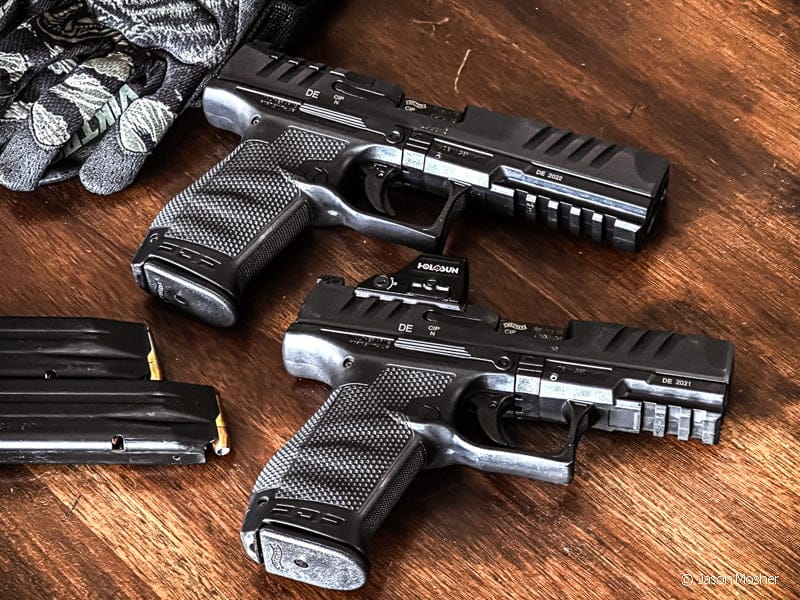
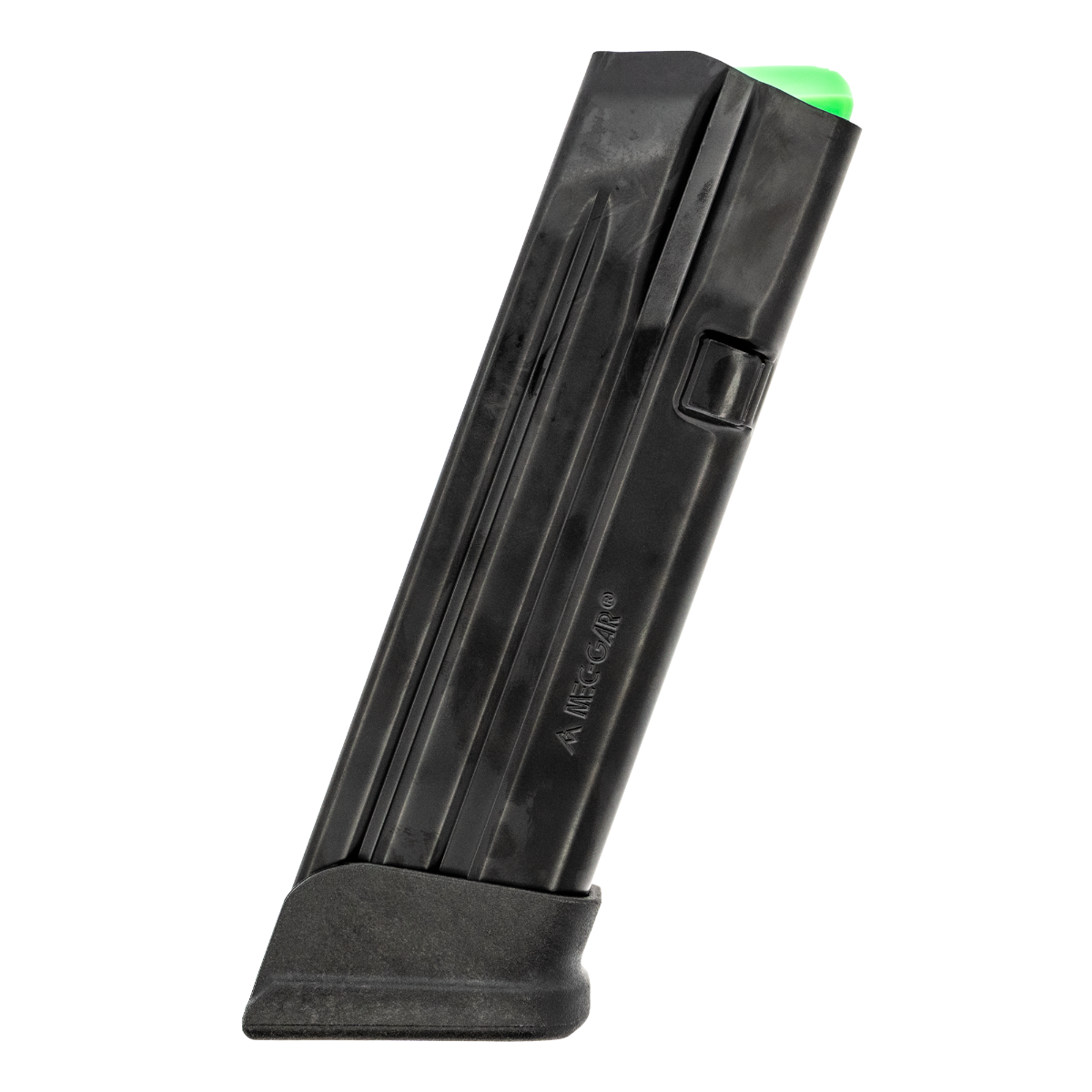
Speaking of mag changes, the mag well on the PDP is flared more than Glock’s, making it easier to change mags. With the angle of the grip, using the slide release and mag release is easy to do, even while shooting. The other two things I want to mention are the slide serrations and trigger guard. Walther’s slide serrations are much deeper than Glock’s, making it easy to grip the slide. The trigger guard is enlarged, leaving plenty of room for those who wear gloves.
Field stripping comparison
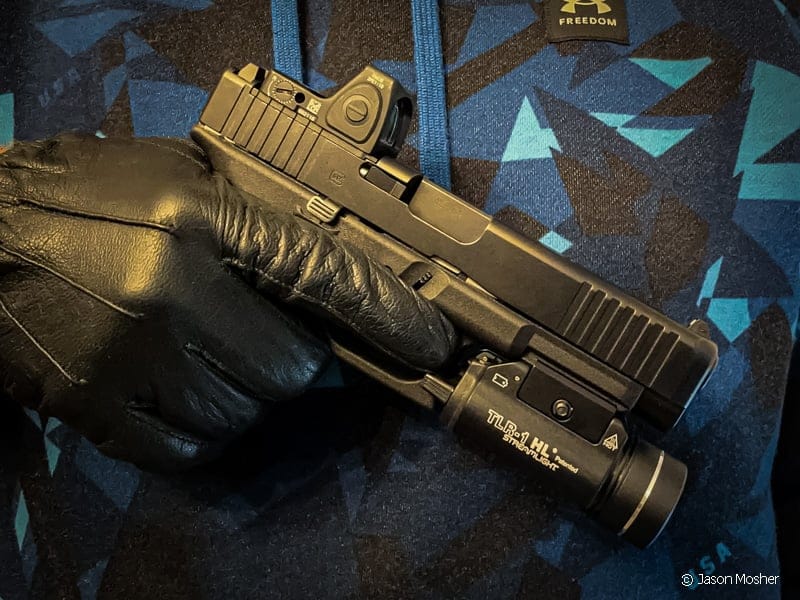
This isn’t really a big deal, but it just irritates me, so I’m going to bring it up. Why did Glock make their slide release lever so small? Walther clearly wins the contest of making this process simple. With a larger square-style lever, the gun comes apart just like a Glock, but it’s easier to do. Last year, we did some drills in the winter and tried field stripping our Glocks with gloves on.
Just about everyone struggled because they were wearing thicker gloves for cold weather. When I got home, I decided to try this with my PDP and was able to do it. Overall, the takedown process is the exact same with each gun; it is just easier with the PDP. Again, this isn’t a huge deal, but I wish Glock had made their takedown lever just a smidge bigger.
Apples and oranges?
Both guns are reliable and have some positive attributes the other misses out on. I’m never shy about saying which gun I prefer, but in this case, it’s a coin toss. I like my Glock 49, the accessories for it, and the red dot adaptor plates you get in the box. The PDP, however, is a great-looking gun that is even more comfortable to shoot. Walther updated their optic plate system from the 1.0 to the 2.0, and I’ve had trouble finding them in stock. I also dislike needing to purchase a plate before mounting an optic. It should come with the gun.